Player acquisition keeps getting more expensive, and the welcome bonus no longer separates one casino from another. Operators run similar libraries and similar offers, whether they launched on turnkey casino software or a custom build. What moves behavior now is the structure around the games: what a player is working toward, how close they are, and what arrives when they get there. This guide covers the mechanics that work, which segment each one fits, the platform modules underneath, and where these programs usually break.
What Gamification Solutions for Online Casinos Actually Do
Gamification solutions for online casinos add game mechanics on top of casino gameplay. Missions, progression levels, leaderboards, and reward systems give players a goal beyond the next spin. The mechanics read player behavior, show progress against a target, and release rewards at defined points. Operators use them to lift session frequency, deposit cadence, and retention.
This is separate from promotional bonusing. A welcome bonus buys a deposit once. A mission that pays out after five sessions in a week builds a pattern the player repeats without a prompt.
The mechanics run on data the casino platform backend already holds: wager size, session length, game choice, and deposit timing. Gamification reads that data and responds while the player is still on site.
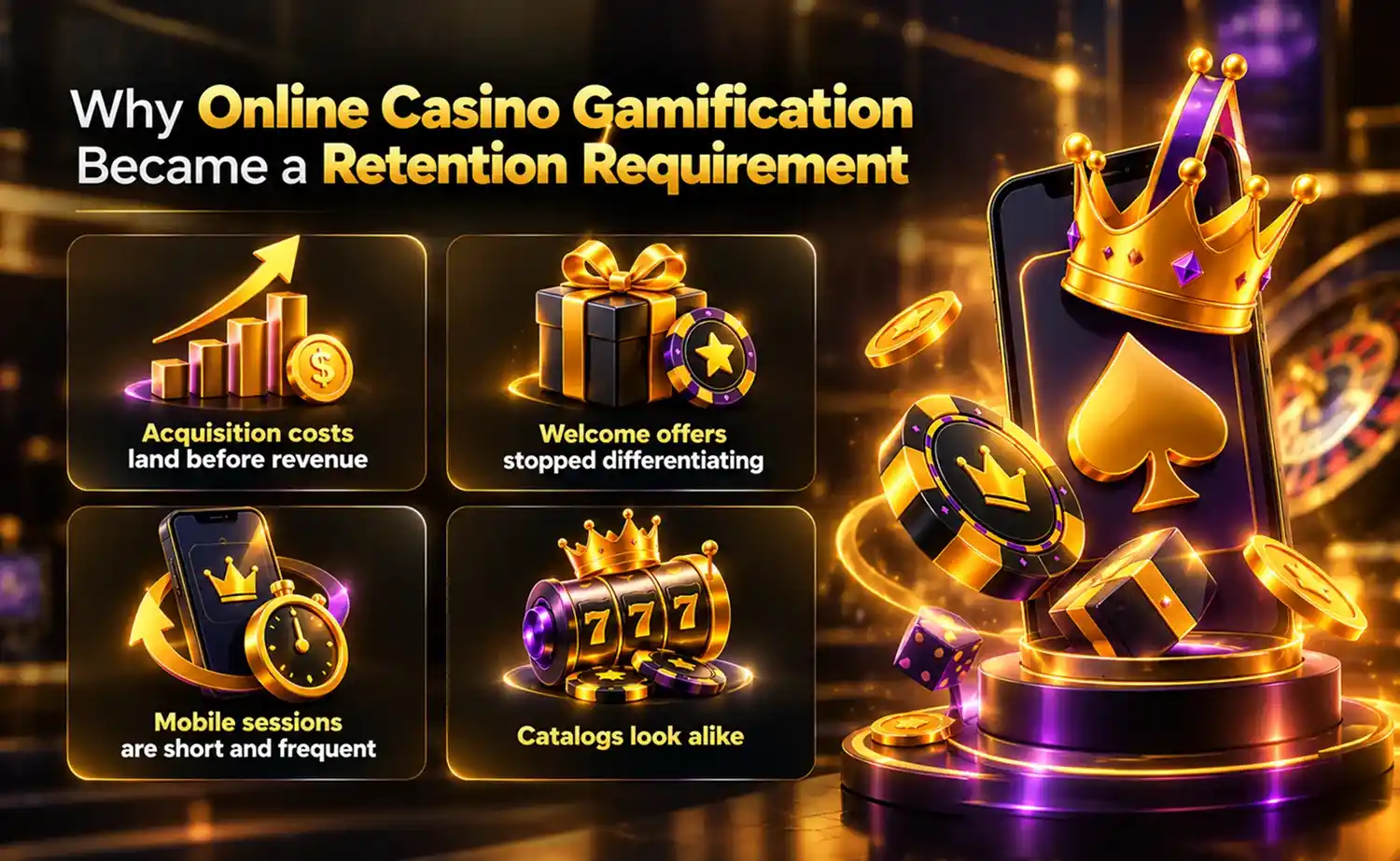
Why Online Casino Gamification Became a Retention Requirement
Reward mechanics used to be a differentiator. Competitive pressure turned them into a standard part of the stack.
Acquisition costs land before revenue
In competitive markets, the first weeks after registration decide whether a player pays back what it cost to bring them in.
Welcome offers stopped differentiating
Players compare bonus terms across five sites in minutes, so the offer itself is no longer a reason to pick one brand.
Mobile sessions are short and frequent
A reward loop that resolves in two minutes fits that pattern. A promotion built around a long evening session does not.
Catalogs look alike
With every major online casino software provider offering thousands of titles through aggregation, the library alone stops being a reason to stay.
Rewards-Based Gamification Strategies in Casinos
Rewards-based gamification strategies in casinos work when the reward is visible before it is earned. Players need the target, the progress tracker and the terms in front of them. Timing matters too, since rewards that arrive on a fixed schedule stop registering as rewards.
Missions and Daily Challenges
Short tasks that reset daily or weekly: play three tables, wager a set amount, try a new provider. Missions lift login frequency and daily active users, and they give casual players a reason to open the app that is not a deposit prompt.
Progression Levels and Achievement Badges
Players climb levels by wagering across the catalog. A visible progress bar keeps the next step in sight, which extends session depth and pushes discovery beyond the three or four titles a player defaults to.
Leaderboards and Tournaments
Timed competitions ranked by wager volume, points, or win multiplier. Tournaments concentrate play into defined windows, which lifts activity on quiet weekdays and gives marketing a fixed event to build campaigns around.
Tiered Loyalty and VIP Rewards
Tiers turn sustained play into status through a custom software casino development company; priority withdrawals, dedicated support, higher limits. Tiered programs hold the high-value segment, as long as each step up is worth the climb it demands.
Prize Wheels, Collectibles and Instant Rewards
Instant mechanics settle on the spot: a spin on return, a collectible that completes a set, a credit after a missed week. These suit reactivation, because a dormant player will not commit to a four-week ladder before seeing anything.
See the Mechanics Live
Missions, tiers, and tournaments running on a real build
Effective Player Engagement Strategies in iGaming
Effective player engagement strategies in iGaming start with segment fit. The mission that activates a casual player reads as noise to a high roller.
| Segment | What motivates them | Mechanic that fits | Metric it moves |
|---|
| High rollers | Status and access | VIP tiers, invitation-only tournaments | Retention in the top revenue decile |
| Casual, low-stakes | Small wins, low commitment | Daily missions, collectibles | Daily active users, session frequency |
| Lapsing or dormant | A reason to reopen the app | Instant rewards, return spins | Reactivation rate |
| Newly registered | Orientation and early proof | Onboarding quests, first-week progression | First to second deposit conversion |
Segment data comes from your casino CRM software rather than a survey. Wager size, session pattern, and days since last deposit sort players into these four groups on their own.
How Gamification Improves the Online Casino Gaming Experience
The online casino gaming experience is judged on what returning feels like, not on the size of one payout. Reward mechanics shape that in four ways.
Progress carries between sessions, so a half-finished ladder gives a player something waiting for them. Rewards feel earned when the rules are published upfront, and the tracker is accurate to the wager. Personalized missions make a 3,000-game catalog navigable, since the next suggestion comes from what the player already plays. Transparency handles the rest: visible terms, clear wagering requirements, and no rule changes mid-campaign.
Responsible gaming controls belong in the same interface. Limits, reality checks and session timers are part of an experience players trust enough to come back to.
The Platform Modules Behind Gamification for Casino Operators
Gamification for casino operators is an integration project as much as a creative one. Seven modules carry the load, and each has a failure mode that shows up in support tickets first.
| Module | What it controls | What breaks without it |
|---|
| Loyalty and points engine | Tier rules, point accrual, benefit unlocks | Tiers drift from actual play and VIPs get downgraded by mistake |
| Mission and achievement engine | Task definitions, progress tracking, completion | Progress resets or double-counts, and support absorbs the complaints |
| Tournament and leaderboard module | Rankings, prize pools, event windows | Standings lag at peak traffic and results get disputed |
| Bonus management system | Reward issuance, wagering terms, expiry | Rewards issue twice or never, and bonus cost runs past budget |
| PAM wallet and profile sync | Balances, identity, limits, exclusion status | Rewards credit stale balances and excluded players stay in campaigns |
| CRM and segmentation | Triggers, audiences, message timing | Every segment receives the same offer |
| Analytics and reporting | Attribution, cohort reporting | No way to show which mechanic paid for itself |
Real-time mechanics depend on platform stability. TIGCasino runs at 99.99% uptime, which matters most in the last minutes of a tournament and during prize-wheel peaks.
Map Your Gamification Stack
Which modules you run, which ones you are missing
How to Measure Casino Player Engagement
Casino player engagement is measurable, provided you baseline before the first mechanic ships. Five numbers are enough:
- Session frequency per active player, measured weekly
- Deposit cadence, measured as days between deposits
- Participation rate, the share of actives completing at least one mission
- Reward cost as a percentage of gross gaming revenue
- Retention at 30 and 90 days, split by whether the player engaged the mechanic
Run the first mechanic on one segment and hold a control group. Compare cohorts across 90 days rather than weeks, since novelty inflates the first fortnight and then fades.
Where Casino Gamification Programs Fail
Reward economics outrun margin
Reward cost as a percentage of gross gaming revenue, tracked against your platform cost base.
Players cannot see their progress
A mechanic running invisibly is a cost with no behavioral return.
Every segment gets the same offer
A high roller shown a small generic reward reads the whole brand as cheap.
Content goes static
Missions that never change get ignored by week three, and the tracker becomes wallpaper.
The layer sits on nothing
Gamification without live account and segmentation data runs on stale balances and yesterday’s audiences.
Compliance Guardrails for Gamified Reward Mechanics
Reward mechanics touch the same rules as any promotion, and regulators treat them that way.
- Publish reward terms, wagering requirements, and expiry before a campaign opens
- Keep missions from pushing players past deposit or loss limits they have set
- Exclude self-excluded and cooled-off accounts from leaderboards, push campaigns, and reward emails
- Check promotional restrictions per market, since some licenses limit how rewards can be advertised
- Log reward distribution so the trail is auditable on request
Build these in as requirements rather than a legal review at the end. Obligations differ by license, so confirm the details with your compliance team for each market you run.
Building Your Gamification Layer With TIGCasino
Reward mechanics only work when the modules under them share the same player data. That is the part most programs get wrong, and it is the part that decides whether a mission tracker is accurate on a Saturday night.
TIGCasino builds that layer into the platform itself, across 100+ deployments and 50+ live operators, with casino software live in three weeks on 0% GGR share. The rest is iteration, and iteration gets easy once the data underneath is right.
FAQ'S