Bonus Abuse vs Player Retention: How Casino Operators Can Balance Growth and Risk

Table of Contents

The Sumsub iGaming Fraud Report finds that overall iGaming fraud has increased by 64% Y-o-Y, which is alarming. Bonus abuse is the exploitation of free spins, deposit matches, and welcoming perks that casinos provide to attract and retain players, but this offering quickly turns into revenue leakage. 

However, not providing these perks, operators risk losing players to their competitors. Among different player retention strategies, bonuses are the most important, but seeing how it’s being turned into a systemic revenue drain, operators are always looking for new ways to prevent bonus abuse fraud and retain players. 

Let’s learn how you strike a balance in bonus abuse vs player retention, know what bonus abuse actually costs you and how to retain players in other ways than giving bonuses.

What is Bonus Abuse in an Online Casino?

Bonus abuse, or promo abuse, in iGaming is the systematic exploitation of promotional offers by online casinos, sports betting platforms, etc., that are initially designed for genuine players. 

So instead of engaging with the platform like an ordinary user, fraudsters exploit the promotional offering without becoming a revenue-generating player for whom that bonus was actually meant.

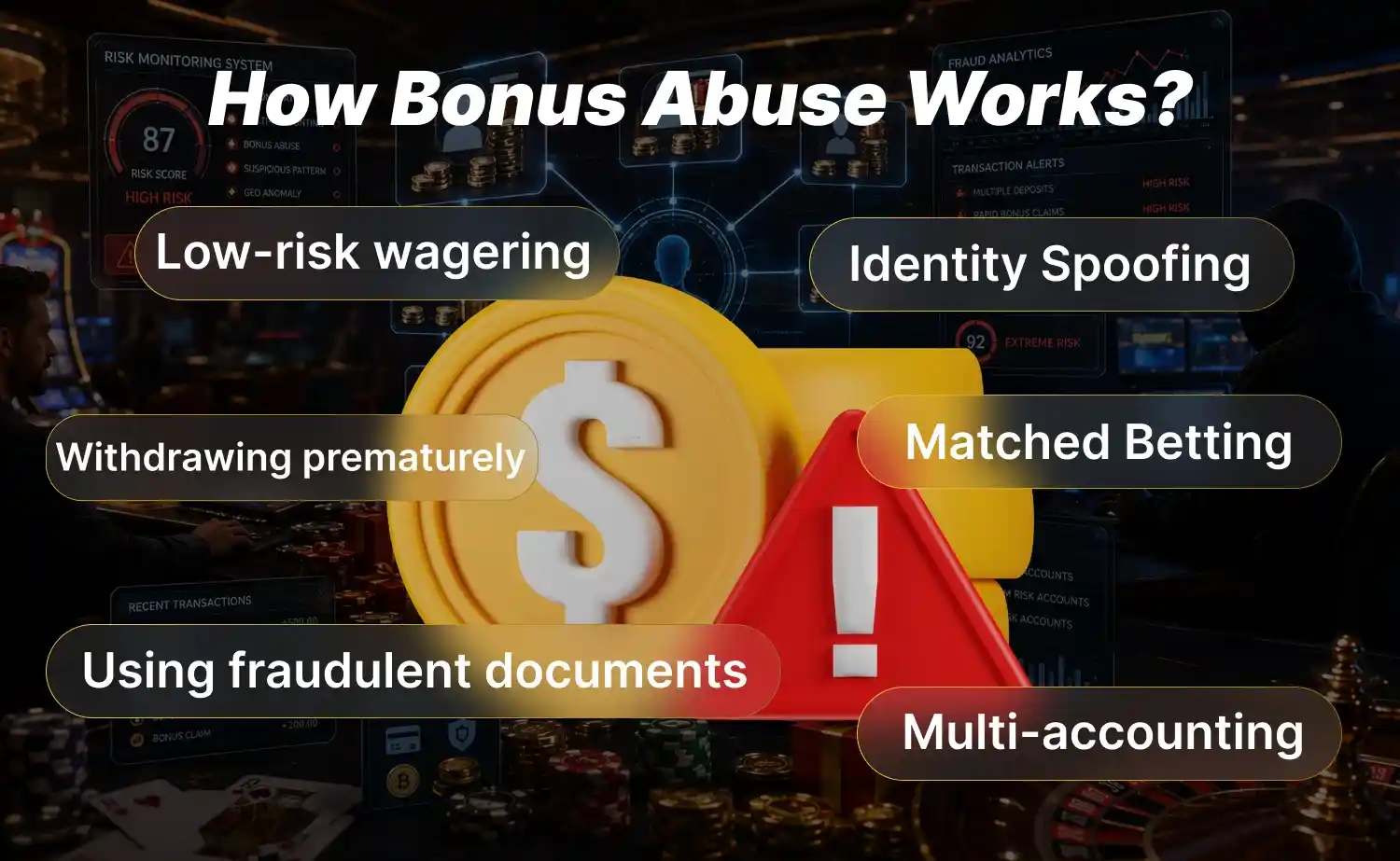
How Bonus Abuse Works?

Fraudsters, accessing the platform as genuine players, manipulate the promotional strategies to minimize their risk while maximizing bonus value, and the common types of abuse include;

  • Multi-accounting: Opening multiple accounts at the same casino to claim bonuses repeatedly, where each account claims a sign-up bonus. Here, device spoofing and residential proxies make every account seem genuine and like it’s created an authentic and first-time user. 
  • Matched Betting: Fraudsters use bonus funds to place opposing bets across different sportsbooks, exchanges, or accounts, effectively eliminating risk while extracting promotional value. The objective is not to win through prediction accuracy but to convert bonus credits into guaranteed cash with minimal exposure.
  • Identity Spoofing: It’s when fraudsters create accounts using stolen identities and synthetic identities to bypass weak KYC checks. Today, AI tools have made identity spoofing easier as generating a photorealistic selfie is only a prompt away. 
  • Low-risk wagering: Placing bets that minimize risk while meeting wagering requirements.
  • Withdrawing prematurely: Attempting to withdraw winnings before meeting wagering requirements.
  • Using fraudulent documents: Submitting fake ID to verify multiple accounts on a single platform and make every transaction seem genuine as it’s completed by a verified user.
How Bonus Abuse Works

Why Bonus Abuse is a Serious Business Risk to your Online Casino?

Bonus abuse is often viewed as a promotional problem, and some operators also consider it as the cost of doing business. However, in reality, it affects multiple operational and financial metrics simultaneously.
  • Direct Revenue Leakage: Every bonus claimed by a non-genuine player increases acquisition costs without creating long-term player value. The operator funds promotional rewards but receives little or no future wagering activity in return.
  • Distorted Marketing Performance: Bonus abusers inflate registration numbers, first-time deposit statistics, and campaign conversion rates. Marketing and consumer support teams may incorrectly assume a promotion is successful when much of the activity comes from non-profitable accounts.
  • Increased Fraud & Compliance Exposure: Bonus abuse schemes are often at crosshairs with several risk types, including;
    • Identity fraud
    • Multi-accounting
    • Payment fraud
    • Money laundering
    With fraud tactics taking a more complex structure, operators face growing pressure to strengthen player verification and transaction monitoring controls.
  • Operational Costs: The time and efforts you dedicated to investigate fraud, review accounts, settle payment disputes, and address customer support requests that could otherwise be focused on player acquisition and retention initiatives.
  • Damage to the Legitimate Player Experience: It’s no surprise that any sort of aggressive abuse prevention measures will create friction for genuine players who don’t signup to commit any fraud. So, when you ask for additional document, build a system to delay withdrawals, and implement unnecessary account restrictions it will erode trust and increase churn, creating retention a complex problem operators are trying to avoid.

9 Ways iGaming Companies Can Identify and Control Bonus Abusers

Effective bonus management in an online casino is not only about preventing abuse, but it’s also an iGaming retention strategy. As when you can control bonus fraud, you will save revenue leakage and work towards balancing player retention and fraud prevention. Here are 10 tested casino bonus abuse detection strategies.

StrategyHow It Helps Detect and Prevent Bonus Abuse
Analyze Suspicious Account Patterns

Look for clusters of accounts sharing;


  • Similar registration details
  • Payment methods
  • IP addresses
  • Devices
  • Gameplay behaviors. 


These patterns often indicate multi-accounting or coordinated abuse.

Participate in Fraud Intelligence NetworksWorldwide, industry-specific data-sharing and research services publish reports of the common fraud methods. They also find and report identities to help operators identify known fraudsters known to commit epeat bonus fraud. 
Implement Robust KYC Verification

In an online casino, when you set up strong identity verification from day one, it doesn’t create as much friction as when you ask for additional documents mid-way. Being vigitalnt from day one helps prevent;


  • Duplicate accounts creation
  • Synthetic identities creation
  • Stolen credential abuse
Track VPN, Proxy, and Device ManipulationIt’s a common practice for bonus abusers to leverage VPNs, residential proxies, device spoofing tools, or emulator software. They use these tools to disguise identity, bypass account restrictions, and show they are playing from a legal country. 
Apply Risk-Based Wagering RequirementsWell-structured wagering requirements make it harder for players to convert promotional value into guaranteed profits through low-risk betting strategies.
Monitor Player Behavior in Real Time

Either manually or using AI for this task, you need to monitor player behavior and in this work on;


  • Tracking deposit patterns
  • Wagering velocity
  • Player’s game selection
  • Session duration
  • Withdrawal behavior 


Use this information to identify accounts focused solely on extracting bonus value. 

Deploy Dedicated Fraud Detection SystemsHere again, we suggest you to use machine learning and advance systems to analyze player behavior. TIGCasino can integrate systems in your online casino to help flag suspicious activity that manual reviews often miss, and using this, you can build a profitable casino bonus strategy. 
Enforce Clear Bonus Terms Consistently

When you set and enforce transparent rules, it will create a stronger basis for players to be cautious and don’t indulge in any sort of fraud behavior. Specifically, set clear terms and conditions for;


  • Player eligibility
  • Wagering requirements
  • Maximum bet limits
  • Withdrawals 


Transparency in rules will create a simplified monitoring system and reduce disputes. 

Segment Players and Personalize Bonus OffersInstead of offering identical promotions to every player, use AI to implement behavioral and value-based segmentation. Using this, you can reward loyal customers while limiting exposure to bonus hunters.

Bonus Abuse vs Player Retention | Framework to Balance Risk and Growth

Successful operators do not treat bonus abuse prevention and player retention as competing priorities. For them, how to prevent bonus abuse and player retention strategies must go simultaneously. 

The goal is to create promotional systems that reward genuine players while making abuse economically unattractive. The following framework provides a practical approach.

Step 1: Detect Abuse Patterns Early

Start by identifying how bonus abuse occurs on your platform, and for this, you must analyze;

  • Account registrations
  • Device fingerprints
  • IP addresses
  • Payment methods
  • Wagering behavior
  • Withdrawal activity. 

Look for patterns like multi-accounting, low-risk wagering, and rapid bonus-to-withdrawal cycles as they will reveal exploitation attempts before losses escalate and help reduce bonus abuse without hurting retention. 

Step 2: Segment Players by Risk and Value

The first rule of casino bonus optimization is that not all players should receive the same promotions. Group users based on;

  • Lifetime value
  • Activity level
  • Deposit history
  • Retention probability
  • Fraud risk

This allows operators to reduce bonus exposure for high-risk accounts while increasing rewards for loyal and profitable players.

Step 3: Shift from Acquisition Bonuses to Retention Bonuses

Large welcome offers tend to attract bonus hunters and should be used judiciously. Casino promotion abuse prevention is a key strategic element, but it can also hurt genuine players. Instead, implement a retention-focused reward strategy where you will only encourage ongoing engagement without affecting other players. Popular retention bonus strategies include;

  • Cashback
  • Loyalty tiers
  • Personalized free spins
  • Missions
  • VIP rewards 

These components create longer-term value while reducing abuse opportunities while protecting genuine players and preventing bonuse abusers from participating. 

Step 4: Apply Dynamic Eligibility Rules

Bonus eligibility should adapt to player behavior and not be universal for all players. For when you want to know how can operators balance bonuses above and player retention, do this: restrict, modify, or approve promotions based on;

  • Risk scores
  • Verification status
  • Wagering history
  • Previous bonus usage. 

This approach protects promotional budgets without introducing unnecessary friction for legitimate users.

Step 5: Measure Promotional ROI Continuously

Every bonus campaign should be evaluated against business outcomes, not just claim rates and the key metrics to trake are;

  • Bonus cost
  • Conversion to first deposit
  • Retention rate
  • Net gaming revenue
  • Player lifetime value
  • Abuse-related losses. 

Promotions that generate activity but fail to produce profitable long-term players should be redesigned or removed.

Conclusion

The real conundrum for an operator what to prefer between bonus abuse vs player retention. However, its never about choosing one or giving preference, it’s about creating a balance. 

Being too strict or having too  many regulations will prevent eve genuine players from signing up but being too relaxed sends an open invitation to fraudsters to exploit your weaknesses. 

Looking to build a smarter bonus and retention strategy? Contact TIGCasino to develop a data-driven promotional framework that maximizes player value while minimizing abuse risk.

FAQ'S

Bonus abuse is the intentional exploitation of casino promotions without adding to revenue generation. Common casino bonus abuse tactics include multi-accounting, identity spoofing, low-risk wagering, bonus stacking, and matched betting designed to extract promotional value while minimizing financial risk.

Bonus abuse increases acquisition costs while reducing promotional profitability. It creates revenue leakage, inflates marketing metrics, consumes operational resources, and can expose operators to broader fraud and compliance risks.

Most operators combine identity verification, behavioral analytics, and fraud detection technology. Device fingerprinting, IP monitoring, transaction analysis, real-time wagering reviews, and risk scoring help identify suspicious activity before significant losses occur.

Strictness in bonus rules needs to be balanced so as to not to prevent genuine players from accessing the promotions, but at the same time deter fraudsters from exploiting the system.

The most effective approach combines segmentation, monitoring, and personalized incentives. Operators should identify abuse patterns early, tailor bonuses based on player value and risk, apply dynamic eligibility rules, and continuously optimize promotions based on measurable business outcomes.

Prish K
By

Charanpreet Singh

Request a Demo