If your digital platform lacks human-led streams, you are missing out on the primary driver of modern iGaming profitability. In 2026, online casino with live dealers command the highest average player lifetime value and represent the definitive baseline for upgrading any digital lobby. We have reviewed 20 of the industry’s premier live dealer casino software providers, giving you a direct look at onboarding workflows, operational expenses, and custom gaming options so you can choose a vendor that fits your immediate business realities perfectly.
Ready to Launch a Premium Live Dealer Casino?

What Is Live Dealer Online Casino Software?
Live dealer online casino software is the specialized architecture allowing internet casinos to stream real human dealers running live physical tables directly to remote players in real time. It serves as an all-in-one matrix combining high-definition video, studio hardware, data tracking units, bet management engines, cross-platform wallet syncs, and administrative toolsets.
If you are running an online casino platform, this is the exact engine processing everything behind the scenes. It takes care of chip placements, hand recognition, automatic payouts, live chat, and instant database settlements so you don’t waste engineering resources building a proprietary solution. Operators usually implement these live dealer streams alongside slots via direct integration or a multi-provider content aggregator.
How Live Dealer Casino Technology Works?
Live dealer casino technology depends on 4 core layers working together.
Understanding each one helps operators choose the right provider and set realistic expectations for integration.
#1 Dealer Studio and Streaming Infrastructure
To replicate a brick-and-mortar casino, operators rely on physical studios. Here, real dealers run the tables using genuine cards and wheels. Multiple HD cameras record the action, utilizing high-speed streaming to keep feed delays under two seconds.
#2 Game Control Unit (GCU)
Each table has a small device that encodes physical actions, a card being dealt, a ball landing into digital data. The GCU is what makes the physical game readable to the software.
#3 Optical Character Recognition (OCR)
This layer automatically captures game results from the cards, dice, and wheels. No manual entry is needed, ensuring the digital game state updates instantly.
#4 Player Interface and Wallet Integration
From the player’s side, the UI manages bets, chat, and game streams. The system links this directly to the backend wallet, pulling funds per bet and settling wins instantly to replicate the feel of the best live online casinos.
For operators, this stack is the difference between a live table that feels smooth and one that lags. Provider quality here directly affects retention.
Why Operators Launch Live Dealer Casino Software?
Live dealer content solves a real business problem. Slots dominate volume, but retention and average session length are strongest on live tables. Operators launching or expanding a live dealer product typically see impact in four areas.
Trust and Transparency
Real dealers and real cards are easier for players to trust than pure RNG output. This shortens the gap between land-based habits and online play, especially for new-to-online audiences.
Longer Sessions, Higher ARPU
Live blackjack and roulette sessions run longer than typical slot sessions. Average bet sizes are usually higher, especially on VIP and branded tables.
High-roller Acquisition
VIP-branded live tables are one of the most effective tools operators have to attract and retain high-value players. Off-the-shelf tables rarely deliver this — branded tables from providers like Evolution or Playtech do.
Cross-vertical Retention
Players who use live tables tend to stay on the platform longer overall, which improves LTV across slots and other verticals too.
For any operator building past MVP stage, live dealer is a revenue lever, not a checkbox.
Key Features of Top Live Dealer Casino Software
When you look at the best live dealer online casino software, it always blends exceptional media quality with robust operational depth. Don’t waste time grading providers against a long generic checklist, focus on five feature clusters that actually move the needle.
1. Streaming and video quality
- HD and 4K streaming with adaptive bitrate for mobile and desktop
- Multi-camera angles, including side and overhead shots
- OCR-backed result reading with millisecond-level accuracy
2. Game portfolio and localization
- Full core library: blackjack, roulette, baccarat, plus game shows
- Native-speaking dealers for target markets
- Localized studios or dedicated tables for regulated regions
3. UI, chat, and player engagement
- Customizable player interface with operator branding
- Real-time chat between players and dealers
- Side bets, tipping, statistics, and dealer profiles
4. Security, fair play, and compliance
- Certified RNG for shuffling where used, plus audited game logs
- Proven game fairness through standard GLI-19 or iTech Labs credential
- Studio operations built directly around UKGC, MGA, and US state compliance frameworks
5. Mobile and cross-platform performance
- Table views optimized for touchscreens instead of shrunken desktop visuals
- Minimal stream latency across everyday 4G and 5G connections
- A fully synchronized user experience on web, Android, and iOS formats
Leading in three of these feature groups makes live casino software providers an ideal fit for enterprise and mid-market platforms. Startups can sometimes trade off portfolio depth for pricing, but streaming quality is non-negotiable at any stage.
Want To Build A Live Dealer Casino Tailored To Your Markets?

Live Dealer Casino Games You Can Offer Players
The live dealer sector has grown massively beyond simple classic blackjack and roulette setups. If you want to engage different player segments today in online live casinos, a modern lobby requires a strategic mix of table classics, interactive game shows, and niche specialty formats.
Blackjack
Offer Speed, Infinite, and Free Bet options. Ensure side action like Perfect Pairs is live to scale up hold margins.
Roulette & Baccarat
Combine standard wheels with multiplier mechanics like Lightning Roulette. Add No Commission Baccarat to draw in serious high-rollers.
Casino Poker
Target analytical players with straightforward titles like Three Card Poker and Ultimate Texas Hold’em.
Game Shows
Bring in casual player traffic using viral, host-led hits like Crazy Time or Monopoly Live.
Niche Classics
Drop in localized regional card games like Andar Bahar, Teen Patti, and Sic Bo to help you lock down specific emerging markets.
The right mix depends on your target audience, but most operators need at least three of the six categories to build the best live dealer online casino experience and compete on lobby depth.
How to Evaluate Live Dealer Casino Software Providers?
Vetting your options across the industry’s live casino software providers requires a strict process. Use these eight criteria to score any partner or specific live dealer software suite before signing.
Streaming Quality
Zero-lag HD or 4K playback, under 2 seconds of latency, and adaptive bitrate streaming. Run mobile stress tests instead of relying on desktop.
Game Portfolio Depth
Lobbies must include standard classics like roulette and blackjack alongside interactive game shows and specific regional formats to compete with the best live online casinos.
Dealer Professionalism and Localization
Native-speaking dealers, studio hours matching your player timezone, and cultural fit for target markets.
Licensing and Certification
Demand clean licensing from Curacao, Malta, or the UK. Ensure technical audits from houses like iTech Labs explicitly approve live dealers over regular RNG.
Integration and API Flexibility
REST or WebSocket APIs, sandbox access, and documented wallet integration. Aggregator access is a plus.
Customization and Branding
Ability to run dedicated tables, branded environments, and custom UI where scale allows.
Mobile and Cross-platform Quality
Native app performance, not just responsive web, to match the layout of the top live casino websites.
Pricing Model and Scalability
Fixed monthly bills, simple revenue sharing, or blended terms. Match their pricing structure directly to your expected transaction volume.
Score each provider 1 to 5 across all eight. Anything below 3 on streaming or licensing is a hard pass.
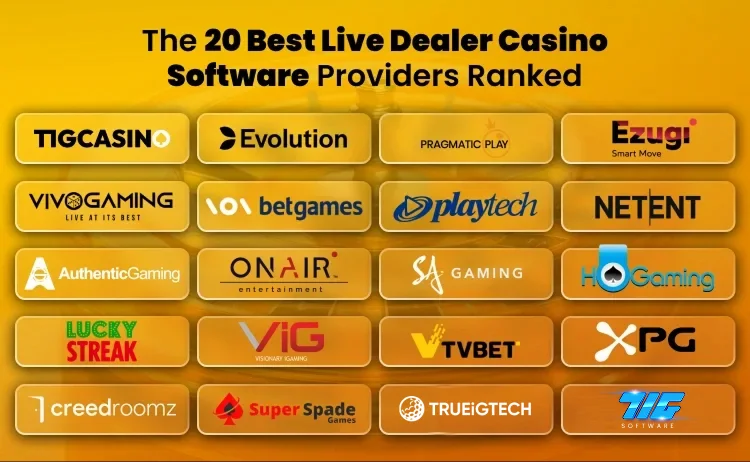
The 20 Best Live Dealer Casino Software Providers Ranked
Finding the right live casino vendor means balancing stream quality, studio locations, and commercial terms. This breakdown evaluates the top live dealer software providers and studios making waves right now, scoring each on market positioning, pricing models, and core engineering strengths to help you choose the right fit for your operation.
1. TIGCasino
Positioning:
An aggregation-first platform built to handle your entire live casino software operation, with bespoke casino software for tailored platform requirements
Studio Location:
A worldwide network of studio partners
Standout Capability:
A single API that plugs hundreds of different tables into your site at once, skipping the headache of signing separate software contracts
Pricing Model:
Scalable hybrid pricing, combining flat fees with standard revenue splits
Target Market:
Startups and mid-tier sites looking to host top-shelf live games immediately with minimal development work
2. TRUEiGTECH
Positioning:
A technology-focused provider offering customizable infrastructure for operators building tailored live casino environments with crypto casino software developmentStudio Location:
Technology infrastructure designed to support diverse operator requirementsStandout Capability:
Custom integrations and backend capabilities for connecting live casino functionality with broader operator systemsPricing Model:
Flexible commercial structures based on platform and customization requirementsTarget Market:
Operators seeking greater control over their live casino technology and deployment
3. TIGSoftwares
Positioning:
A casino technology provider focused on flexible deployment, game integration, and operator-focused infrastructure for live gaming operationsStudio Location:
Access to integrated live casino content across multiple gaming environmentsStandout Capability:
Flexible casino games development designed to bring live dealer content into a connected casino platformPricing Model:
Scalable models based on deployment requirementsTarget Market:
Startups and growing operators seeking flexible live casino integration
4. Evolution Gaming
Positioning:
Premium live content and highly interactive, host-driven entertainmentStudio Location:
A massive global footprint spanning Latvia, Malta, Georgia, Colombia, and the USStandout Capability:
Visual blockbusters like Funky Time and Crazy Time, backed by unmatched infrastructure for dedicated physical tablesPricing Model:
Premium revenue sharing that commands top dollarTarget Market:
Large-scale international operators who need a bulletproof high-roller product and instant regulatory clearance
5. Pragmatic Play Live
Positioning:
A fast scaling supplier built primarily around excellent mobile-friendly interfacesStudio Location:
Operating streaming hubs out of Bucharest, Sofia, São Paulo, and CebuStandout Capability:
Mega Wheel variants and automated speed tablesPricing Model:
Competitive revenue shareTarget Market:
Mid-scale operators looking for stable secondary live feeds
6. Ezugi
Positioning:
Specialized regional table gaming expert owned by the Evolution groupStudio Location:
Romania, Peru, Colombia, LatviaStandout Capability:
Native localized titles like Andar Bahar, Teen Patti, and EZ Dealer RoulettePricing Model:
A flat monthly fee or a basic percentage of your revenueTarget Market:
Small, agile operators looking for a quick, low-risk launch template
7. Vivo Gaming
Positioning:
Multi-jurisdiction provider specializing in foundational, stable core tablesStudio Location:
San José (Costa Rica), Sofia, ManilaStandout Capability:
Cost-effective HTML5 streams optimized for legacy mobile devicesPricing Model:
Hybrid flat-fee entry optionsTarget Market:
Budget-conscious launches seeking standard live dealer games
8. BetGames
Positioning:
Non-traditional live gaming studio blending fixed-odds betting with casual drawsStudio Location:
VilniusStandout Capability:
Fast-paced, automated lottery and wheel configurationsPricing Model:
Fixed revenue shareTarget Market:
Sportsbooks seeking an intuitive bridge product to cross-sell to sports bettors
9. Playtech Live
Positioning:
Enterprise omni-channel giant offering full system integrationsStudio Location:
Riga, Manila, Lima, BucharestStandout Capability:
Branded network integration with native progressive jackpots (Age of the Gods)Pricing Model:
Revenue share with strict monthly minimum guaranteesTarget Market:
Publicly listed tier-1 corporations and legacy iGaming enterprises
10. NetEnt Live
Positioning:
Curated live dealer niche operation within the unified Evolution ecosystemStudio Location:
MaltaStandout Capability:
Clean, chromakey-backed blackjack and roulette interfacesPricing Model:
Integrated network revenue shareTarget Market:
European operators requiring a visually minimalist desktop and mobile UI
11. Authentic Gaming
Positioning:
Pure real-venue streaming broadcasting live from real brick-and-mortar casino floorsStudio Location:
Foxwoods (US) alongside several land-based European casinosStandout Capability:
Multi-camera immersion directly over physical roulette tables on active resort floorsPricing Model:
Premium revenue shareTarget Market:
Brands courting traditional land-based players who value physical authenticity over studio lighting
12. OnAir Entertainment
Positioning:
Scalable live provider focused on Bespoke Casino Software branding assetsStudio Location:
RigaStandout Capability:
Flexible modular UI customization for digital studio backdropsPricing Model:
Scale-dependent revenue shareTarget Market:
Mid-market brands wanting to spin up tailored environments efficiently
13. SA Gaming
Positioning:
Highly localized, prominent Asia-facing live dealer platformStudio Location:
PhilippinesStandout Capability:
Rich baccarat configurations, dynamic Sic Bo, and multi-window bettingPricing Model:
Region-specific revenue shareTarget Market:
Operators focused heavily on East and Southeast Asian player demographics
14. HoGaming
Positioning:
Legacy Asian live dealer brand supporting entry-tier networksStudio Location:
PhilippinesStandout Capability:
Ultra-low-bandwidth streaming mechanics built for unstable networksPricing Model:
Entry-tier volume pricingTarget Market:
Developing jurisdictions where players face limited mobile data connectivity
15. Lucky Streak
Positioning:
Independent European developer managing a tightly optimized card portfolioStudio Location:
RigaStandout Capability:
Highly responsive dealer interactions and clean card-recognition analyticsPricing Model:
Revenue share without high minimum barriersTarget Market:
Mid-tier European brands seeking uncrowded, dependable tables
16. Visionary iGaming
Positioning:
Multi-game provider specializing in turn-key community betting gamesStudio Location:
Costa RicaStandout Capability:
Dynamic multi-seat Blackjack Early Payout modulesPricing Model:
Structured flat and hybrid optionsTarget Market:
Turnkey setups needing built-in community chat interfaces
17. TVBET
Positioning:
Streamlined 24/7 live-lottery provider emphasizing swift game sessionsStudio Location:
LatviaStandout Capability:
Live parlay betting directly built into draw mechanicsPricing Model:
Low revenue shareTarget Market:
Multi-vertical operators looking for casual, quick-draw ancillary content
18. XPG Live
Positioning:
Hardened value provider focusing on high-action table formatsStudio Location:
PhilippinesStandout Capability:
Straightforward, accessible API integration without complex software bloatPricing Model:
Low baseline revenue shareTarget Market:
Startups needing rapid, low-friction integration
19. CreedRoomz
Positioning:
Regional expert dominant across CIS and Middle Eastern operators.
Studio Location:
Armenia.
Standout Capability:
High variety of regional variants alongside customizable physical setups.
Pricing Model:
Flexible commercial parameters.
Target Market:
Brands heavily targeting Middle Eastern and CIS languages.
20. Super Spade Games
Positioning:
Targeted live studio delivering classic South Asian games.
Studio Location:
Philippines.
Standout Capability:
Great camera quality and zero lag on local favorites like Andar Bahar and Teen Patti.
Pricing Model:
Entry-level tier pricing.
Target Market:
Emerging South Asian digital casino operators.
Live Dealer Casino Software Comparison: Features, Pricing, and Integration
The comparison table below summarizes all 18 providers across the dimensions operators care about most when shortlisting: studio location, game type coverage, target market, pricing model, integration complexity, and regulatory coverage.
| Provider | Game Types | Target Market | Pricing Model | Integration |
| TIGCasino | Full core + aggregated | Startups, Mid-scale | Hybrid (scalable) | Low |
| TRUEiGTECH | Live casino + customizable | Growth-stage, Enterprise | Flexible | Medium |
| TIGSoftwares | Live dealer + aggregated | Startups, Mid-scale | Scalable | Low |
| Evolution Gaming | Full + game shows | Enterprise, VIP | Rev share (high) | Medium |
| Pragmatic Play Live | Full core + shows | Mid-scale | Rev share | Medium |
| Ezugi | Full + regional | Emerging markets | Rev share | Low |
| Vivo Gaming | Core tables | Startups | Hybrid | Low |
| BetGames | Betting-style | Sportsbook ops | Rev share | Low |
| Playtech Live | Full + branded | Enterprise | Rev share + min | High |
| NetEnt Live | Blackjack, Roulette | Premium brands | Rev share | Medium |
| Authentic Gaming | Real-venue roulette | European | Rev share | Medium |
| OnAir Entertainment | Full core | Mid-scale | Rev share | Low |
| SA Gaming | Baccarat-heavy | Asia | Rev share | Low |
| HoGaming | Blackjack, Baccarat | Startups | Rev share (low) | Low |
| Lucky Streak | Blackjack variants | European mid-market | Rev share | Low |
| Visionary iGaming | Full core | White-label brands | Hybrid | Low |
| TVBET | Betting-style | Sportsbook ops | Rev share | Low |
| XPG Live | Blackjack, Roulette | Startups | Rev share (entry) | Low |
| CreedRoomz | Full core + regional variants | CIS & Middle Eastern operators | Flexible | Low |
| Super Spade Games | South Asian classics (Andar Bahar, Teen Patti) | Emerging South Asian operators | Entry-level tier | Low |
Choose the Right Live Dealer Casino Software Provider for Your Business
No single provider fits every operator. Use your business stage, target market, and product depth to shortlist.
No single provider fits every operator. Use your business stage, target market, and product depth to shortlist.
For Startups
Priority is speed, minimized cost, and simple integration. Look at Vivo Gaming, CreedRoomz, and XPG Live. However, launching with a single budget studio can limit your market appeal. Utilizing an aggregator like TIGCasino, one of the best live casino game providers, allows startups to secure flat-fee or hybrid pricing protections while instantly gaining access to a massive library of tier-1 games that usually require enterprise capital.
For Mid-Scale Operators
You need portfolio breadth, mobile-first product, and stronger branding options without enterprise-level minimum commitments. Pragmatic Play Live, OnAir Entertainment, and Lucky Streak are strong shortlists. At this stage, instead of managing multiple direct API contracts, many mid-scale operators utilize TIGCasino to unify their backend administration, layering in specialized studios across diverse geographic regions without introducing tech bloat.
For Enterprise Operators
Portfolio depth, branded VIP tables, and extensive regulated-market coverage matter more than upfront cost. Evolution Gaming and Playtech Live are the two default enterprise choices, often deployed together for redundancy. To maximize operational efficiency, enterprise teams frequently route these legacy networks through an agile single-API architecture like TIGCasino to ensure high-performance uptime, simpler content curation, and reduced live casino development cycles.
For Emerging Market Operators
Localization, native-speaking dealers, and regional format coverage decide winners here. Ezugi, SA Gaming, and Super Spade Games lead for Latin America and Asia. CreedRoomz is a strong fit for Turkish, Russian, and Middle Eastern markets. To optimize traffic and target multiple territories at once, smart operators look for an open, flexible aggregation system that can house all of these localized feeds under a single, unified backend interface.
Cost and Pricing Models for Live Dealer Casino Software
Live dealer content is not priced like standard slots. While general casino software development cost figures cover your foundational infrastructure, live vendor commercials specifically fall into three main models, each impacting your cash flow and unit economics differently.
| Model | How It Works | Best For / Advantages | Limitations |
| Revenue Share | Provider takes 10 to 25% of GGR depending on volume and content mix. | Startups and growth-stage operators. No minimum, aligned incentives. | Gets expensive at high GGR; effective cost rises with scale. |
| Licensing Fee | Fixed monthly or annual fee, sometimes with a per-table cost. | Enterprise operators with high, predictable volume. Predictable cost, higher marginal profit. | High commitment upfront, weaker ROI if volume falls short. |
| Hybrid Model | Lower revenue share plus a base fee, or rev-share with a floor / ceiling. | Mid-scale operators moving from launch to scale. Balances cash flow and cost ceiling. | Contract complexity; effective rate depends on volume band. |
Ask any provider for their expected effective rate at your projected GGR before you sign. That number, not the headline percentage, determines the long-term cost.
Integration Workflow and Technical Considerations
Integrating a live dealer provider is usually a four-step process, and the biggest cost driver is scope, not provider choice.
- You’ll start with discovery, signing an NDA to pull API docs and test supported protocols like REST or WebSockets in a sandbox environment.
- From there, you connect the game flows to your wallet or PAM architecture, the precise step where most launch delays happen due to real-time settlement and refund bugs.
- Next comes backend configuration, where you cherry-pick your table limits, branding guidelines, and chat rules.
- Finally, you move to end-to-end testing, focusing heavily on load limits and handling dropped user sessions before a staged rollout.
Your actual launch window depends entirely on the framework you choose.
For instance, rather than building custom code blocks for individual suppliers, platforms that decide to integrate 200+ casino game providers simultaneously via a pre-configured aggregator typically move much faster.
Typical timelines:
- Turnkey deployment: 4 to 8 weeks
- White-label integration: 6 to 10 weeks
- Bespoke live dealer build: 8 to 16 weeks
See How TIGCasino Simplifies Live Dealer Integration
Budget QA and load testing carefully. Skimping here is where most launch-day issues come from.
Regulatory Compliance and Licensing for Live Dealer Casino Software
Live dealer software is one of the more heavily regulated formats in online gaming. Operators need to verify both the provider’s licensing and their studio-level compliance.
Global Regulators
Expanding worldwide usually requires licensing from Malta (MGA) or the UK (UKGC), alongside setups in Curacao and the Isle of Man.
US State Gaming Boards
American markets demand state-by-state approval from local boards in New Jersey, Michigan, Pennsylvania, and West Virginia.
Certifications
GLI-19 for interactive gaming systems and iTech Labs certification are the two most common technical certifications for live dealer content.
Verify certification at the studio level too, not just the corporate entity.
Future Trends in Live Dealer Casino Software 2026 to 2027
The live dealer space changes almost monthly. If you are choosing a partner for your casino software development right now, you can’t just look at what is currently on the market, you have to buy into their future roadmap. Radical upgrades in live formats and streaming tech are hitting the scene fast, and your players are going to expect these newer features from day one.
AR and VR Immersive Tables
Studios are piloting augmented mobile screens and full virtual reality card rooms. These won’t go mainstream immediately, rolling out first for exclusive high-roller segments.
AI-Driven Personalization
Lobbies now use behavioral data to instantly recommend specific dealers, open seats, and tailored side-bets. Early versions are active via Evolution and Playtech.
5G-Native Mobile Streaming
Lower latency, higher bitrate, and fewer dropped sessions on mobile. Expect 5G-optimized studios to become a differentiator.
Blockchain and Provably Fair Verification
More live dealer providers are exploring on-chain result logging for crypto-first operators.
Gamification and Social Multiplayer
Multi-player tournaments, leaderboards, and social features built into live tables.
Robotic Camera Arms and Smart Studios
Automation is reducing studio costs and enabling smaller operators to launch dedicated tables.
Note: Companies investing heavily across two or more of these areas will easily outpace the competition in the coming years.
Conclusion
At the end of the day, your live dealer casino software provider will make or break your player retention and your bottom line. It’s that simple. Picking the right one isn’t about finding the flashiest product on the market; it’s about knowing your own limits. Be realistic about what you can afford, figure out exactly which markets you are chasing, and find a partner that fits your actual size today, not just where you hope to be in five years.
Ready to Upgrade Your Lobby?
Schedule a live platform demo with our team today to explore our full live dealer software capabilities.
FAQ'S

Raj Thomas