Payment infrastructure can decide how quickly an online casino grows, how smoothly players deposit, how confidently they withdraw, and how safely operators manage fraud, compliance, and settlement risk. For iGaming operators, choosing the best payment gateways for online casino operations is not a simple checkout decision. It is a high-risk infrastructure decision tied to licensing, approval rates, chargebacks, KYC, AML, payout speed, player trust, and platform scalability.
Online casinos need specialized casino payment gateways because gambling transactions are often classified as high-risk. Standard payment processors may reject casino merchants, limit transaction volume, delay settlements, or suspend accounts when risk signals increase. That is why operators need iGaming payment gateway solutions built around gaming merchant category codes, regional payment rules, alternative payment methods, e-wallets, open banking, crypto payments, and fraud prevention.
This guide compares leading casino payment providers and explains where each gambling payment gateway fits within an online casino payment stack.

A strong casino payment gateway comparison should look beyond fees. Operators need to compare payment coverage, settlement speed, payment method depth, fraud tools, crypto support, integration complexity, and high-risk suitability. The table below compares the best payment gateway for online casino operators based on scale, payment layer, fiat and crypto support, and operator use case.
| Provider | Payment Layer | Proof / Scale Signal | Fiat / Crypto Support | Best For |
| TIGCasino Payment Gateway Integration | Casino platform integration layer | Connects payment flows with PAM, wallet, KYC, fraud, reporting, and operator dashboards | Fiat + crypto depending on operator setup | Operators wanting payment gateways connected with casino platform logic |
| Nuvei | Global PSP / payment technology platform | Supports 200+ markets, nearly 150 currencies, and 40 cryptocurrencies; Nuvei also references 720+ APMs in its global payment-method coverage | Fiat + crypto | Global operators needing broad payment-method coverage |
| Trustly | Open banking / Pay by Bank PSP | Connects 9,000+ merchants, 650M+ consumers, 12,000 banks, and 30+ markets; processed nearly $100B in 2024 | Fiat bank payments | Operators wanting direct bank payments and open banking flows |
| Worldpay | Enterprise payment processor / acquirer | Global gaming payment solution with gambling payment support and card payout requirements for gambling MCCs | Fiat, limited crypto | High-volume regulated operators needing enterprise acquiring stability |
| Skrill | E-wallet PSP | Digital wallet used for betting and gaming; supports international transfers in 40+ currencies | Fiat, limited crypto | Operators needing familiar e-wallet support for iGaming players |
| Neteller | E-wallet PSP | Research data lists 200+ countries and 28+ currencies for Neteller | Fiat + limited crypto | Operators targeting high-volume wallet users |
| Paysafecard / Paysafe | Prepaid / payment group | Research data lists ~50 countries and 40+ currencies for Paysafecard | Fiat prepaid | Operators serving unbanked or privacy-conscious players |
| CoinsPaid | Crypto PSP | Research data lists 25+ cryptocurrencies and a 0.5–1% fee signal | Crypto | Crypto casinos and stablecoin-ready payment flows |
| PaymentIQ | Cashier + orchestration | Long-standing iGaming cashier and PSP routing platform | Via partner PSPs | Operators needing all-in-one cashier and payment orchestration |
| Praxis | Cashier + orchestration | Common in MGA and UKGC operator stacks | Limited crypto via partners | Regulated EU operators needing smart routing |
| NMI | Gateway infrastructure | Gateway-only model connecting merchants to acquiring banks | Fiat | Operators needing flexible high-risk acquiring relationships |
| EMS / PaymentCloud | High-risk merchant services | High-risk merchant account support, underwriting, APMs, and compliance guidance | Fiat + APMs depending on setup | US and high-risk operators needing merchant account support |
TIGCasino iGaming Payment Gateway Integration is best suited for operators that want online casino payment processing connected directly with casino platform operations. In online casinos, payment gateways should not sit separately from the product. Deposits, withdrawals, wallets, bonuses, KYC, fraud controls, player account management, and reporting must work together.
TIGCasino supports payment gateway integration as part of a broader casino platform environment. This makes it useful for operators that want to connect payment flows with advanced casino PAM and management modules instead of managing payments as a disconnected third-party tool.
Major Services:
Pros and Cons for Operators
| Pros | Cons |
| Connects payments with casino platform logic | Not a standalone PSP like Nuvei, Trustly, or Worldpay |
| Useful for operators needing payment + PAM + wallet alignment | Final payment method coverage depends on selected gateway partners |
| Supports fiat and crypto payment models depending on setup | Requires clear payment strategy before integration |
| Strong fit for scalable casino platform builds |
Nuvei is one of the strongest global casino payment providers for operators that need wide payment-method coverage across multiple regions. It supports pay-ins, payouts, alternative payment methods, local acquiring, multi-currency payment gateways for casinos, and crypto capabilities.
For online casino operators, Nuvei’s value comes from payment depth. Operators expanding across multiple regions often need cards, local payment methods, bank transfers, e-wallets, and crypto support inside one payment strategy. Nuvei’s infrastructure can support that kind of multi-market online casino payment processing complexity.
Nuvei states that it connects merchants across 204 markets, supports local acquiring in 45 markets, and offers support for 480+ local and alternative payment methods, nearly 150 currencies, and 40 cryptocurrencies. Its broader payment-method materials also reference 720+ alternative payment methods for global payment coverage.
Major Services
Pros and Cons for Operators
| Pros | Cons |
| Strong global payment-method coverage | Pricing and setup depend on region, volume, and risk profile |
| Supports fiat and crypto payment flows | May be more complex than smaller single-market gateways |
| Good fit for international operators | Approval still depends on licensing and underwriting |
| Useful for operators needing multi-currency support | Operators may still need local PSPs in specific markets |
Trustly is a strong option for operators that want open banking and direct bank payment flows. Instead of relying on card networks, Trustly enables players to pay directly from their bank accounts through Pay by Bank infrastructure.
For casino operators, this can reduce card-decline friction and support faster, bank-authenticated deposits and withdrawals in supported markets. Trustly is especially relevant in regulated environments where open banking adoption is strong and players prefer direct bank payments.
Trustly states that it connects 9,000+ merchants to 650+ million consumers through 12,000 banks across 30+ markets, and processed nearly $100 billion in total payments value in 2024.
Major Services
Pros and Cons for Operators
| Pros | Cons |
| Strong open banking coverage | Limited to supported regions and bank networks |
| Reduces card network dependency | Not a crypto payment solution |
| Useful for faster bank-based payments | Player adoption depends on local open banking familiarity |
| Strong fit for regulated markets | May need to be combined with cards, wallets, or crypto for full coverage |
Worldpay is a major enterprise payment processor with gaming payment capabilities. It is best suited for larger regulated operators that need enterprise card acquiring, payment stability, and global processing infrastructure.
For online casinos, Worldpay’s strength is not lightweight onboarding. It is scale, card processing maturity, risk controls, and enterprise-grade payment operations. Operators with significant transaction volume and strict regulatory requirements may consider Worldpay when payment reliability and acquiring stability are more important than quick setup.
Major Services
Pros and Cons for Operators
| Pros | Cons |
| Strong enterprise payment infrastructure | Selective onboarding for gambling merchants |
| Good fit for high-volume regulated operators | Longer due-diligence and setup timelines |
| Supports gaming payment use cases | Less flexible for early-stage or smaller operators |
| Strong acquiring and settlement maturity | Pricing and terms are usually enterprise-specific |
Skrill is a widely recognized digital wallet and payment method in online betting, gaming, and cross-border payments. For online casino operators, Skrill is useful because many players already understand e-wallet deposits and withdrawals, especially in iGaming-heavy markets.
Skrill’s value is player familiarity and wallet-based payment flow. It can act as a middle layer between the player’s bank and casino account, reducing direct exposure of banking details and supporting faster wallet transactions where available.
Skrill’s official website positions the product for betting, online gaming, international money movement, and digital wallet payments. Skrill also states that users can send money online in more than 40 currencies.
Major Services
Pros and Cons for Operators
| Pros | Cons |
| Strong recognition in betting and gaming | Availability varies by market and operator approval |
| Useful for e-wallet-heavy player segments | Fees may be higher than some local bank rails |
| Supports multi-currency wallet use | Not a full payment orchestration platform |
| Can improve payment trust for familiar users | May need to be combined with cards, bank rails, and crypto |
Neteller is another major e-wallet under the Paysafe ecosystem and is often considered alongside Skrill in iGaming payment stacks. For operators, Neteller can be valuable because some high-volume players prefer wallet-based payment flows and may use Neteller as their primary casino funding method.
Neteller’s role is similar to Skrill, but it can serve a different player segment. Operators often support both Skrill and Neteller because player preferences overlap but are not identical.
Research lists Neteller with 200+ countries, 28+ currencies, and crypto support through partner integrations, positioning it as a multi-currency wallet option for iGaming operators.
Major Services
Pros and Cons for Operators
| Pros | Cons |
| Strong fit for wallet-first casino users | Fees and availability vary by region |
| Useful for high-volume or experienced players | Not a direct substitute for card acquiring or bank payments |
| Complements Skrill in the payment stack | Requires operator approval and market suitability |
| Can improve payment flexibility | Best used as part of a multi-method cashier |
Paysafecard is a prepaid online payment method under the Paysafe ecosystem. It is especially useful for online casino operators targeting players who prefer cash-based online payments, do not want to use a bank card, or want separation between casino activity and their primary banking account.
For casino operators, Paysafecard is valuable because prepaid payments reduce chargeback exposure. The player buys a prepaid code first and then uses that value to deposit online. Paysafe describes its eCash solutions as prepaid and postpaid payment methods that help merchants reach cash-dependent audiences, with a 100% payment guarantee and no chargeback risk.
This makes Paysafecard especially relevant for regions where card usage is limited, banking access is uneven, or players prefer prepaid spending control.
Major Services
Pros and Cons for Operators
| Pros | Cons |
| Reduces card chargeback exposure | Usually deposit-focused, not a complete withdrawal solution |
| Useful for unbanked or cash-preferring players | Not ideal for players who prefer instant digital wallets |
| Supports privacy-conscious payment behavior | Coverage varies by country and local retail availability |
| Strong addition to a multi-payment cashier | Operators still need separate withdrawal methods |
CoinsPaid is a crypto payment infrastructure provider for operators looking for casino payment gateways with crypto support. It is especially relevant for crypto casinos, hybrid casino platforms, and international operators serving players who prefer wallet-based payment flows, stablecoins, and faster crypto settlement.
CoinsPaid positions itself as blockchain payment infrastructure for global commerce and offers crypto payment gateway capabilities. Research also lists CoinsPaid as an iGaming-native crypto PSP with 25+ cryptocurrencies, global coverage, and a 0.5–1% fee signal depending on volume and conversion requirements.
For operators, CoinsPaid can reduce traditional chargeback exposure and support faster crypto settlement. However, crypto-focused gambling payment gateways require AML monitoring, wallet screening, source-of-funds checks, and jurisdictional review.
Major Services
Pros and Cons for Operators
| Pros | Cons |
| Strong fit for crypto casinos and stablecoin payments | Crypto rules vary by jurisdiction |
| Can reduce traditional chargeback exposure | Requires wallet screening and AML monitoring |
| Supports faster crypto settlement | Volatility risk exists unless stablecoins or conversion tools are used |
| Useful for international payment coverage | Not ideal as the only payment method for mainstream fiat users |
PaymentIQ is a cashier and payment orchestration platform used by many iGaming operators. Unlike a single PSP, it helps operators connect, route, and manage multiple payment providers through one orchestration layer.
This matters because most online casinos should not rely on one payment provider. A strong payment stack usually needs cards, bank rails, e-wallets, prepaid methods, crypto, local payment options, and backup processing routes. PaymentIQ helps operators route payment traffic across multiple PSPs instead of managing each integration separately.
Major Services
Pros and Cons for Operators
| Pros | Cons |
| Reduces the need to integrate every PSP separately | Hosted cashier can limit brand control compared with native cashier UX |
| Useful for multi-provider payment stacks | Pricing and setup can be enterprise-oriented |
| Helps improve routing and redundancy | Final method coverage depends on connected PSPs |
| Strong fit for iGaming payment operations | Operators still need underlying PSP relationships and approvals |
Praxis is another cashier and payment orchestration platform commonly evaluated by operators in regulated iGaming markets. It is positioned around smart routing, cashier management, and multi-PSP support.
For operators, Praxis can be useful when the payment challenge is not only “which provider should we use?” but “how do we route payments across multiple providers, currencies, countries, and player segments?” This is especially important for operators working across regulated European markets or brands with several payment partners.
Major Services
Pros and Cons for Operators
| Pros | Cons |
| Strong fit for regulated EU operator stacks | May be more than early-stage operators need |
| Supports smart routing and multi-PSP setups | Cashier experience may depend on hosted implementation model |
| Useful for payment redundancy | Final PSP coverage depends on commercial setup |
| Helps operators manage regional payment complexity | Requires careful payment rules and routing strategy |
NMI is different from many PSPs because it is primarily gateway infrastructure rather than a direct casino-focused processor. It can connect merchants to acquiring banks and payment partners, which can be useful for high-risk operators that need more flexibility in their acquiring setup.
For online casino operators, NMI’s value comes from not being locked into a single acquirer. Casinos often need backup acquiring routes, fraud tools, tokenization, and routing flexibility. A gateway infrastructure model can help operators build a more resilient card payment setup when paired with the right high-risk merchant account.
This is especially relevant for operators that already have acquiring relationships or work with high-risk payment brokers who can support gambling merchant accounts.
Major Services
Pros and Cons for Operators
| Pros | Cons |
| Flexible gateway infrastructure | Not a complete casino payment solution by itself |
| Can support multiple acquiring relationships | Requires compatible high-risk acquirer |
| Useful for operators avoiding single-acquirer dependency | Gambling approval still depends on underwriting partners |
| Strong technical gateway model | Operators may need more hands-on payment expertise |
EMS and PaymentCloud represent the high-risk merchant services side of casino payments. These providers are not just “payment buttons.” Their value is in helping gambling operators approach underwriting, merchant accounts, processor relationships, APMs, documentation, and high-risk approval.
This category matters especially for operators targeting the USA or other high-risk markets where standard processors often decline gambling merchants. In these cases, the issue is not only the gateway. It is whether the operator can get approved, maintain processing stability, manage chargebacks, and meet processor documentation requirements.
Major Services
Pros and Cons for Operators
| Pros | Cons |
| Useful for high-risk and US-facing casino operators | Terms depend heavily on licensing, risk, volume, and jurisdiction |
| Helps with underwriting and processor access | Fees and reserves may be higher than mainstream processing |
| Can support international payment structuring | Not always as plug-and-play as standard gateways |
| Valuable for newer operators needing hands-on support | Approval is not guaranteed |
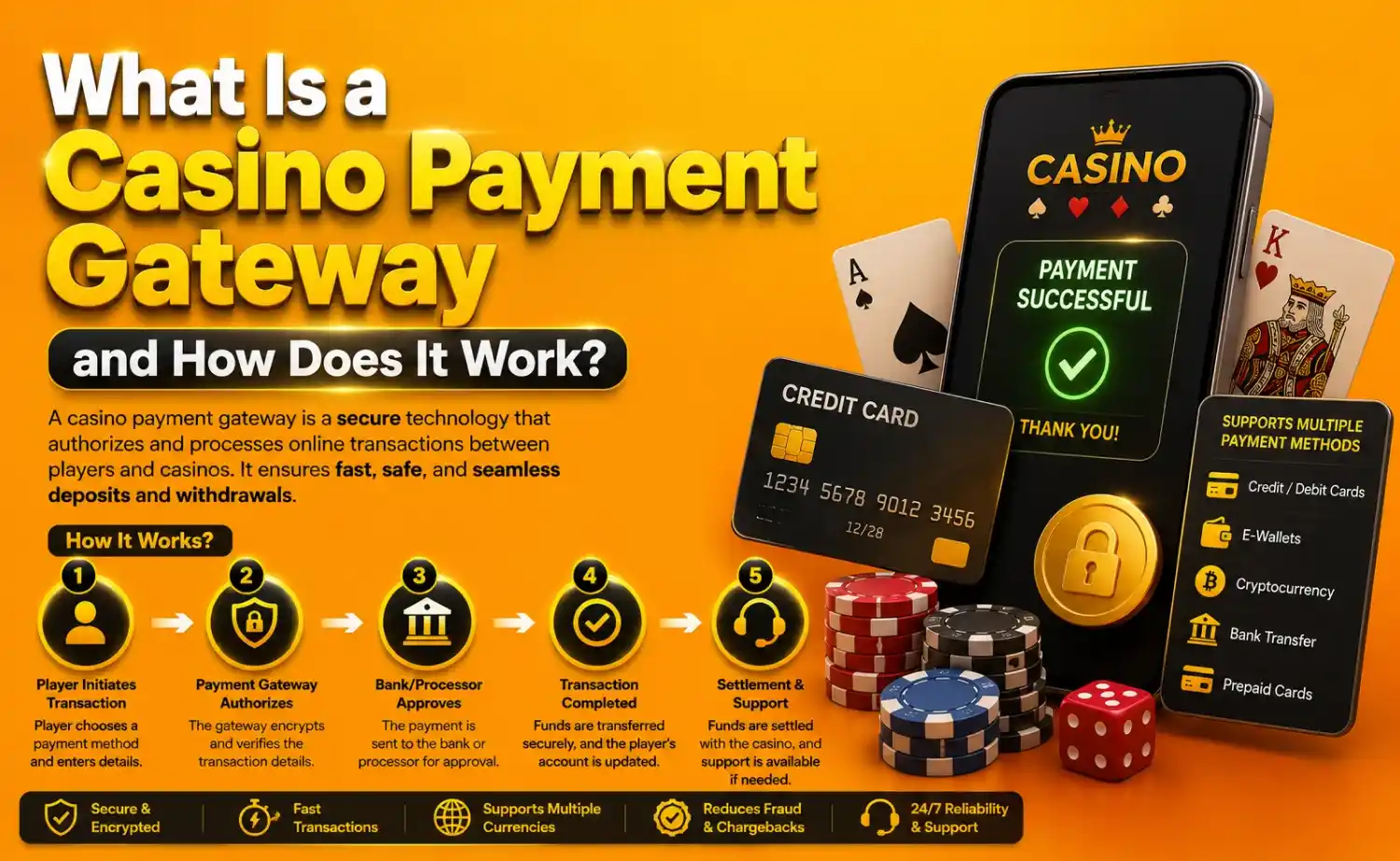
A casino payment gateway is a secure system that authorizes, routes, verifies, and processes player deposits and withdrawals between an online casino platform and payment networks such as card processors, banks, e-wallets, crypto wallets, prepaid systems, or alternative payment providers.
In simple terms, this is how casino payment gateways work: the player starts a deposit or withdrawal, the gateway encrypts and routes the payment request, the payment provider or bank approves or declines it, and the casino platform updates the player wallet or transaction status.
A casino payment gateway usually supports:
For deeper technical planning, operators should evaluate advanced casino API integration for payment systems early in the platform architecture.
When comparing the best payment gateway for online casino operators, decision-makers should look beyond basic deposit support. The right gateway should support high approval rates, secure withdrawals, fraud prevention, chargeback management, multi-currency processing, crypto compatibility, API integration, and scalable payment routing.
| Operator Type | Recommended Payment Direction |
| Startup casino | Use a flexible gateway stack with cards, e-wallets, and local APMs before adding advanced orchestration |
| Regulated-market operator | Prioritize licensed-friendly PSPs, KYC/AML alignment, open banking, card acquiring, and reliable payouts |
| International operator | Use multi-currency gateways, local payment methods, e-wallets, and backup PSPs |
| Crypto casino | Add crypto PSPs such as CoinsPaid or CoinGate-style rails with wallet screening and stablecoin support |
| Enterprise casino | Use orchestration, multiple PSPs, card acquiring, bank rails, fraud tools, and reporting dashboards |
| US-facing operator | Prioritize high-risk merchant account support, ACH, card acquiring, chargeback tools, and state licensing requirements |
| Sweepstakes platform | Use payment rails that align with the sweepstakes model, prize logic, legal structure, and player verification needs |
Before signing with any provider, operators should ask:
For operators building a wider platform, payments should connect naturally with the complete turnkey casino platform solution rather than being bolted on after launch.
Even with strong gateways, casino operators face payment friction. The goal is not to eliminate every issue, but to build infrastructure that can detect, route, and recover from payment problems quickly.
| Challenge | Operator Impact | Practical Solution |
| High payment declines | Lost deposits and lower conversion | Use local payment methods, smart routing, and backup PSPs |
| Chargebacks | Merchant account risk and financial losses | Add chargeback alerts, fraud scoring, and dispute workflows |
| Slow withdrawals | Player frustration and support tickets | Use e-wallets, open banking, faster payouts, or crypto where permitted |
| Regional payment limits | Poor conversion in specific markets | Add local payment methods and region-specific PSPs |
| Fraud attacks | Stolen cards, account takeover, bonus abuse | Connect payments with fraud monitoring and player risk tools |
| Single-gateway dependency | Downtime or frozen processing | Maintain multiple gateway and PSP relationships |
| Compliance gaps | Licensing and AML risk | Align payments with KYC, AML, reporting, and verification rules |
| Poor cashier UX | Abandoned deposits | Surface preferred methods and reduce unnecessary steps |
Payment issues are not only back-office problems. They directly affect acquisition ROI, player trust, deposit conversion, retention, and platform reputation.
For operators handling card disputes, payment failures, and suspicious transactions, secure online casino payment fraud prevention strategies should be treated as part of the gateway selection process.
TIGCasino helps operators build casino platforms where payment gateway integration connects with the wider operating stack. This includes player accounts, wallet systems, KYC, AML, fraud controls, bonuses, withdrawals, reporting, and admin dashboards.
This matters because casino payments are not just payment events. They are player lifecycle events. A failed deposit can affect acquisition. A delayed withdrawal can damage trust. A suspicious payment can trigger risk review. A bonus-linked deposit can affect wagering logic. A high-value cashout can require additional verification.
TIGCasino can support operators with:
For operators comparing standalone gateways, the stronger question is not only “which provider should we integrate?” It is also “how will this gateway work inside the platform?” That is where an enterprise casino management system integration platform can create long-term operational value.
The best payment gateways for online casinos are not chosen by brand recognition alone. Operators need payment infrastructure that can handle high-risk classification, deposit conversion, fast withdrawals, chargebacks, fraud prevention, multi-currency processing, compliance, and long-term scalability.
For modern operators, the strongest payment strategy is usually not one gateway. It is a layered stack built around region, licensing, player preference, risk tolerance, and platform architecture.
Looking for scalable casino payment gateway integration? Speak with TIGCasino’s iGaming payment specialists to explore tailored payment infrastructure for your casino platform.

Prish K


Request a Demo
Get a quick look at your potential earnings. Answer four simple questions and see your projected revenue for year one.
Keep in mind, this quick analysis is a preliminary guideline meant to kickstart your detailed market research. Best of luck!
Enter your email to receive your full cost breakdown, including projected net revenue, operating margin, and editable line items for your own planning.
Your inputs are used only to generate and deliver your report and are handled in line with TIGCasino's Privacy Policy.