Key Takeaways
Reviewed by TIGCasino Editors
What separates casino apps that generate short-term traction from platforms that scale into $10M+ ARR businesses? In most cases, the difference is infrastructure, retention systems, and operational scalability.
In 2026, building a successful casino app is no longer just about launching games quickly or spending aggressively on player acquisition. High-growth operators are now focusing on scalable backend architecture, payment efficiency, CRM automation, analytics maturity, and long-term monetization systems that support sustainable revenue growth.
Many casino apps attract early traffic, but very few scale into profitable eight-figure recurring revenue platforms. As player activity increases, weak infrastructure often creates payment friction, operational inefficiencies, retention problems, and rising support costs that limit profitability.
The most successful casino businesses now approach casino app development as an infrastructure-first operation rather than a simple gaming product. Their platforms are designed to optimize every major revenue driver, including wallet performance, player lifecycle management, cloud scalability, transaction processing, retention automation, and modular integrations.
This shift has become even more important as acquisition costs continue rising across affiliates, paid advertising, influencer partnerships, and search visibility. Sustainable ARR growth now depends less on traffic volume and more on how efficiently the platform converts, retains, monetizes, and re-engages players over time.
The casino apps reaching $10M+ ARR are often not the ones spending the most on marketing. They are usually the platforms with the strongest operational systems behind the scenes.

Launching a casino app and scaling it to $10M+ ARR are completely different challenges. Early-stage growth often depends on acquisition, but long-term revenue growth depends on infrastructure, retention systems, payment efficiency, and operational scalability.
As platforms grow, even small operational issues can impact revenue significantly. Slow withdrawals reduce player trust, weak analytics limit optimization, and unstable infrastructure creates retention problems that become harder to fix at scale.
According to industry market estimates, the global online gambling market is projected to surpass $150 billion in the coming years, increasing competition among casino platforms and making operational efficiency a major growth advantage.
High-growth casino apps typically focus on:
| Area | High-Growth Platforms |
| Retention | Automated CRM and lifecycle systems |
| Payments | Fast and scalable withdrawals |
| Infrastructure | Cloud-native and modular architecture |
| Analytics | Real-time player insights |
| Monetization | Lifetime value optimization |
The casino apps reaching $10M+ ARR are usually not the ones spending the most on acquisition. They are the platforms with the strongest backend systems, retention infrastructure, and long-term scalability planning.
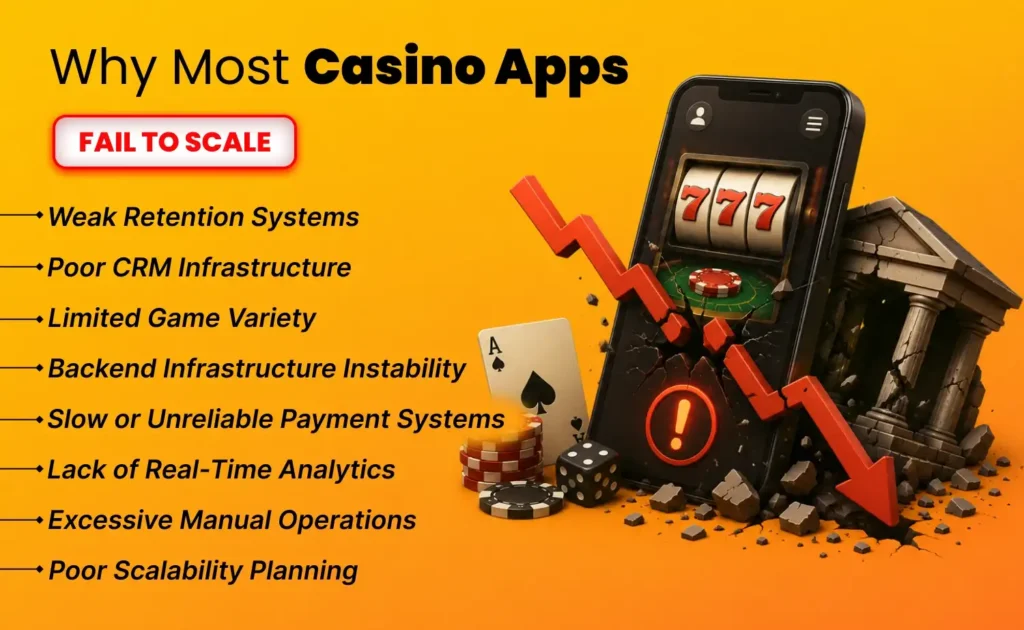
Many casino apps focus heavily on acquisition while underinvesting in player retention. Without strong lifecycle management and reactivation systems, platforms struggle to monetize users profitably over time.
Operators lacking segmentation, personalized rewards, behavioral targeting, and automated campaigns often experience higher churn rates and lower player engagement.
Delayed withdrawals, failed deposits, and wallet friction quickly reduce player trust. In competitive gambling markets, users rarely tolerate poor payment experiences for long.
Traffic spikes during sporting events, tournaments, or promotions can overwhelm poorly optimized systems. Downtime and lag directly impact revenue, gameplay quality, and retention.
Platforms with smaller or outdated game libraries often struggle to maintain long-term engagement. Players expect fresh content, diversified gaming options, and regular releases.
Without advanced analytics systems, operators struggle to identify profitable acquisition channels, churn triggers, VIP behavior, underperforming games, and monetization opportunities.
Manual fraud checks, support workflows, reporting, and promotional management become increasingly inefficient as player volume grows. Lack of automation raises operational costs significantly.
Many casino apps generate early traction but fail to prepare for long-term growth. Weak infrastructure, inefficient operations, and rising operational friction eventually limit ARR expansion.
The casino platforms that scale successfully usually prioritize infrastructure resilience, retention-driven monetization, automation, and operational efficiency from the beginning.
Scalable casino apps are built on interconnected infrastructure systems designed to support growing player activity, transaction volume, and operational complexity without creating performance bottlenecks. As the online gambling market continues expanding globally, operators increasingly rely on infrastructure quality to improve retention, payment efficiency, and long-term revenue scalability.
Modern casino platforms require scalable backend systems capable of handling traffic spikes during sporting events, tournaments, and promotional campaigns. High-growth operators typically use:
The goal is maintaining stable performance even during periods of heavy activity.
Most scalable casino apps integrate multiple game providers to maximize engagement and content diversity. Strong aggregation infrastructure supports:
Payment infrastructure directly affects player trust and monetization. Successful casino apps prioritize:
As platforms expand globally, payment systems become increasingly important for retention and operational efficiency.
Industry reports project the global online gambling market to exceed $150 billion in the coming years, increasing the importance of scalable infrastructure and high-performance payment systems for competitive operators.
Scalable casino apps rely heavily on automated retention systems to maximize player lifetime value. Core CRM infrastructure usually includes:
Real-time analytics helps operators optimize acquisition, retention, monetization, and gameplay performance continuously. At the same time, fraud systems protect operational stability through:
As casino apps scale, manual workflows become inefficient. Automation infrastructure helps reduce operational overhead across support management, CRM execution, reporting, compliance monitoring, payment systems, and VIP management.
The most scalable casino platforms are not simply gaming apps. They are operationally engineered ecosystems designed to support long-term revenue growth efficiently.
The foundation of long-term casino growth starts with selecting the right business model. While white-label platforms allow faster market entry, custom casino infrastructure provides greater flexibility, payment control, analytics ownership, and scalability. Many high-growth operators also combine casino gaming, sportsbook features, VIP systems, and affiliate monetization to diversify revenue streams.
As casino platforms scale, transaction activity increases rapidly across deposits, withdrawals, wallet transfers, and bonus systems. High-growth operators invest heavily in:
Fast payment processing directly improves player trust, retention, and deposit frequency.
Many casino apps fail because they scale acquisition before building strong retention systems. Operators reaching $10M+ ARR typically focus heavily on:
Studies across gaming and SaaS industries consistently show that improving retention significantly increases long-term profitability and lifetime value.
High-performing casino apps treat game portfolio management as an ongoing optimization process. Successful platforms combine:
Operators continuously analyze gameplay behavior, retention patterns, and session duration to improve monetization efficiency.
Scalable casino growth depends on diversified acquisition channels rather than relying on a single traffic source. High-growth operators usually combine:
SEO and affiliate ecosystems remain especially valuable because they compound long-term acquisition efficiency.
As casino platforms grow, operational complexity increases rapidly. Successful operators automate:
Real-time analytics dashboards help optimize acquisition ROI, player behavior, retention, and transaction performance continuously.
The final stage of scaling focuses on maintaining efficiency while expanding into larger markets. Cloud-native infrastructure, modular APIs, and localization-ready systems allow operators to scale faster without rebuilding backend architecture repeatedly.
The global online gambling market is projected to exceed $150 billion in the coming years, making scalable infrastructure, retention systems, and payment efficiency increasingly important competitive advantages for casino operators.
The casino apps successfully reaching $10M+ ARR are usually not the ones relying only on aggressive marketing. They are the platforms built around operational efficiency, scalable infrastructure, and retention-driven monetization systems.
Fast deposits and withdrawals directly improve player trust, retention, and deposit frequency. High-growth casino apps prioritize low-friction payment experiences across fiat and crypto systems.
Modern casino platforms increasingly use AI-powered recommendation systems, behavioral targeting, and personalized promotions to improve engagement and player lifetime value.
Automated CRM systems help reduce churn through reactivation campaigns, loyalty rewards, segmented bonuses, and lifecycle-based communication strategies.
The most scalable casino apps rarely depend on a single revenue stream. Many combine casino gaming, sportsbook integrations, VIP ecosystems, affiliate revenue, and tournaments to stabilize recurring revenue growth.
Cloud infrastructure allows casino platforms to handle high concurrent traffic during tournaments, sporting events, and promotional campaigns without downtime or gameplay instability.
Scalable operators invest heavily in transaction monitoring, device fingerprinting, AML systems, and risk-scoring automation to protect operational stability and profit margins.
Advanced analytics systems help operators optimize acquisition performance, retention behavior, gameplay engagement, payment efficiency, and VIP segmentation continuously.
As transaction volume grows, automation becomes essential across support systems, reporting, CRM execution, payment monitoring, and player management workflows.
Industry studies show that improving player retention by just 5% can significantly increase long-term casino platform profitability. This is why many high-growth casino apps now invest more heavily in CRM automation, AI-driven personalization, fast payment systems, and retention infrastructure rather than relying only on aggressive player acquisition.
Building a casino app to hit $10M ARR in 2026 requires far more than launching a visually appealing gaming platform. The operators scaling successfully are building infrastructure-driven businesses focused on retention, transaction efficiency, analytics maturity, and operational scalability.
Long-term casino app monetization depends heavily on backend architecture, payment reliability, CRM automation, and lifecycle management systems that improve player value over time. Acquisition may drive initial growth, but retention and operational efficiency ultimately determine whether a platform scales sustainably.
The casino apps achieving eight-figure ARR are rarely the ones relying purely on aggressive marketing. They are the operators building scalable ecosystems capable of handling growth efficiently while continuously improving monetization performance.
In an increasingly competitive iGaming landscape, infrastructure quality is becoming one of the strongest long-term growth advantages a casino platform can have.

Prish K


Request a Demo
Get a quick look at your potential earnings. Answer four simple questions and see your projected revenue for year one.
Keep in mind, this quick analysis is a preliminary guideline meant to kickstart your detailed market research. Best of luck!
Enter your email to receive your full cost breakdown, including projected net revenue, operating margin, and editable line items for your own planning.
Your inputs are used only to generate and deliver your report and are handled in line with TIGCasino's Privacy Policy.