Key Takeaways
Reviewed by TIGCasino Editors
A casino loyalty program is a structured system that rewards players for their activity, deposits, wagers, or visits with points, tier status, or direct perks like cashback and free spins. Players earn credit for play and redeem it for rewards, while operators use the same data to segment players and reduce churn. Most programs run on a tiered structure, so the more a player engages, the more they unlock.
For operators, a loyalty program isn’t a marketing add-on. It’s the mechanism that turns a first deposit into a repeat player, and repeat players into most of a casino’s actual revenue.
The mechanics are simple on the surface and carry real engineering weight underneath: every wager or deposit earns points, points accumulate toward tier status, and tier status unlocks better rewards. Getting this right means the platform’s PAM and bonus engine need to track activity in real time, not batch it overnight.
Points typically accrue per unit wagered, sometimes weighted by game type, since slots, table games, and live dealer titles carry different margins and house edges. Some programs also award points for account actions, deposits, verified logins, referrals, that have nothing to do with wagering, to reward engagement beyond raw spend.
A typical ladder runs Bronze through Diamond, with each tier requiring more cumulative activity than the last and unlocking progressively better terms: faster withdrawals, higher deposit limits, dedicated account management, and exclusive promotions. The jump between tiers should feel earned, not arbitrary; tier thresholds set too close together cheapen the status; set too far apart, and players disengage before reaching the next one.
Redemption usually happens through a rewards shop or a direct cashback conversion; points convert to bonus funds, free spins, or comps at a fixed rate. The redemption experience matters as much as the earning rate: a rewards catalog that’s slow or confusing undercuts a program’s value regardless of how generous the point structure is.
Want to see how points, tiers, and redemption work together on a live platform?
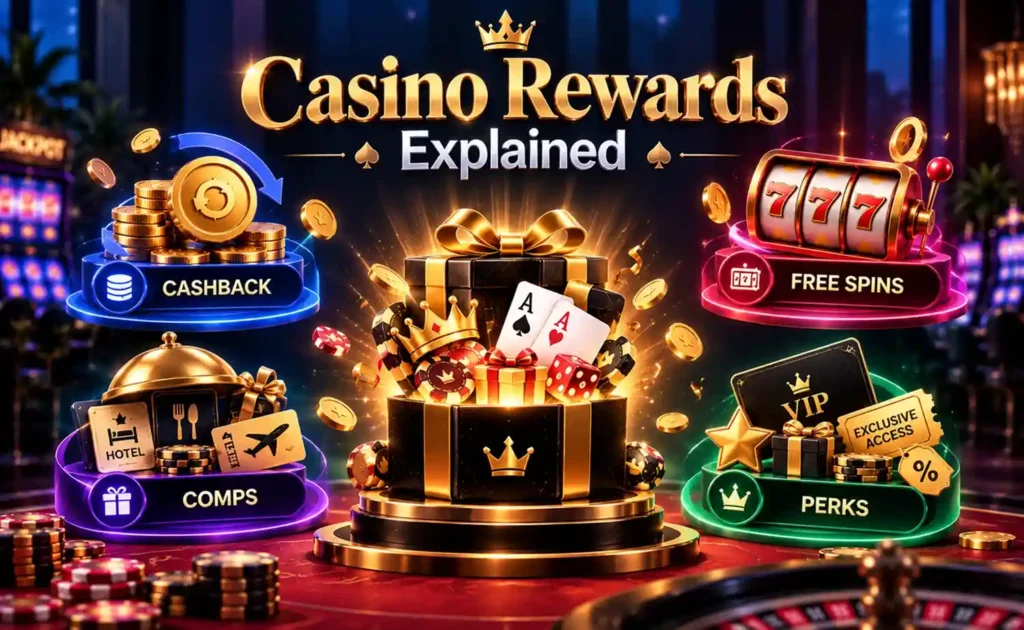
Casino rewards programs typically draw from four reward types, often combined rather than offered in isolation.
The best-performing programs weight these differently by player segment rather than offering the same mix to everyone. A high-frequency low-stakes player responds to free spins and small cashback; a high-value infrequent player responds more to withdrawal speed and dedicated support. Either way, a casino rewards loyalty program only works if redemption is as fast as earning.
There’s no single best casino loyalty program design; the right model depends on player base, game mix, and margin structure. The following models cover most of what’s actually deployed:
| Model | Earning mechanic | Reward type | Best-fit segment | Setup effort | Main drawback |
| Points-only | Wager-based points | Direct redemption | Broad, low-touch | Low | Feels generic without tiering |
| Tiered VIP | Cumulative activity | Status-based perks | High-value players | Moderate | Slow to build engagement at entry level |
| Cashback | Net loss percentage | Direct cash return | Loss-averse players | Low | Margin-sensitive at scale |
| Gamified / mission-based | Challenges, streaks | Badges, bonus unlocks | Younger, engagement-driven players | High | Needs constant content refresh |
| Hybrid | Combination of above | Mixed | Diverse player bases | High | Complex to communicate clearly |
Evaluating any model against six criteria keeps the decision grounded: how clearly players understand the earning mechanic, how the reward type matches player behavior, how much operational effort the model demands, how well it scales as the player base grows, how defensible the margin is at volume, and how well it integrates with existing CRM and bonus infrastructure.
See how flexible tier and reward logic actually gets configured on a live platform.
Online casino loyalty programs run on continuous, automated tracking rather than a physical card swiped at a slot machine or table. Every wager, deposit, and login is logged instantly, so tier progress and online casino rewards update in real time instead of on a monthly statement cycle. That immediacy also lets online programs personalize offers far more precisely; a land-based club knows a player visited; an online platform knows exactly which games they played and at what stakes.
The trade-off is faster expectations. A land-based player tolerates a mailed offer weeks later; an online player expects a relevant reward within the session it was earned.
A welcome bonus is a one-time acquisition incentive, offered once, to a new player, regardless of how they subsequently behave. A casino loyalty bonus is recurring and earned, tied directly to ongoing activity through the points and tier system described above.
The two serve different purposes in the player lifecycle: welcome bonuses get a player to deposit for the first time, loyalty bonuses give them a reason to keep depositing after the novelty of the welcome offer wears off. A platform that over-invests in welcome bonuses and underbuilds its loyalty structure tends to see strong signups and weak retention, exactly the pattern a loyalty program exists to fix.
See how loyalty and tier logic gets built into the platform rather than bolted on.
A player with tier status has a switching cost a first-time depositor doesn’t; walking away means forfeiting progress, not just a balance. That switching cost is what turns loyalty programs into one of the more durable retention levers available to an operator, compared to promotions alone.
Tiered structures reward increased spend with proportionally better terms, nudging average spend upward without the operator needing to run constant promotional campaigns to achieve the same effect.
Every point earned is a data point: which games, what stakes, what time of day, how consistently. Feeding that into a CRM software platform turns a loyalty program from a rewards mechanism into a segmentation engine that sharpens every other retention campaign the operator runs.
The platform needs to support flexible earning rules by game type and custom tier thresholds, not a fixed, one-size structure that can’t be adjusted as the player base matures.
Redemption needs to be fast and clearly presented; a rewards catalog that requires support tickets to navigate is a retention liability, not a feature.
Missions, streaks, and leaderboards add an engagement layer beyond pure spend-based tiers, particularly effective with younger or more casual player segments. TIGCasino’s casino PAM handles player segmentation, bonus logic, and loyalty tracking as one connected system.
Loyalty data is only useful if it’s visible. A platform that reports engagement and redemption patterns in real time, rather than in a monthly export, lets an operator adjust the program before a segment disengages, not after.
For operators comparing full-stack options, TIGCasino’s bespoke casino software supports custom loyalty logic built around a specific player base rather than a fixed template.
The most common mistake is designing the reward structure before defining the player segments it’s meant to serve, producing a program that looks complete but doesn’t map to actual player behavior. A close second is under-resourcing the redemption experience; most design effort goes to earning, and redemption becomes an afterthought, exactly the part players interact with most.
A loyalty structure that rewards volume alone, without deposit limits, reality checks, or self-exclusion options built into the same system, creates a program that incentivizes exactly the behavior responsible gambling tooling exists to catch. Any tier or points system needs to sit inside a casino management system that enforces safer-play controls alongside the reward logic, not as a separate compliance layer bolted on after the fact.
Ready to launch a loyalty program that’s built into compliance from day one, not added after?

Prish K

Request a Demo
Get a quick look at your potential earnings. Answer four simple questions and see your projected revenue for year one.
Keep in mind, this quick analysis is a preliminary guideline meant to kickstart your detailed market research. Best of luck!
Enter your email to receive your full cost breakdown, including projected net revenue, operating margin, and editable line items for your own planning.
Your inputs are used only to generate and deliver your report and are handled in line with TIGCasino's Privacy Policy.