(TL;DR)
Reviewed by TIGCasino Editors
Most operators researching how to start a crypto casino start with the platform question. The bigger risk usually sits earlier: a licence that looks fine on paper but doesn’t work with the payment providers, game suppliers, or markets the business actually needs.
Launching a crypto casino means defining the target market, choosing a jurisdiction, picking a platform model, structuring payments and wallets, sourcing games, building compliance controls, and planning acquisition, in that order. Crypto gambling was valued at roughly $6.6 billion in 2025 and is projected to reach $17.1 billion by 2032.
This guide walks through those eight decisions in the sequence that avoids the licence-payment mismatch above, whether the goal is a crypto-native build or adding crypto rails to an existing brand.
A crypto casino is an online gambling platform that accepts cryptocurrency for deposits, wagering, and withdrawals. Depending on its architecture, player funds may sit in custodial wallets managed by the operator or interact directly with a blockchain network. Many platforms also use provably fair mechanics that let players independently verify certain game outcomes rather than trust the operator’s word for it.
Some platforms run crypto exclusively; others combine it with fiat rails as a hybrid model. That choice reshapes the cashier, wallet architecture, licensing strategy, and compliance requirements from day one, a fork operators researching how to create a crypto casino tend to underestimate.
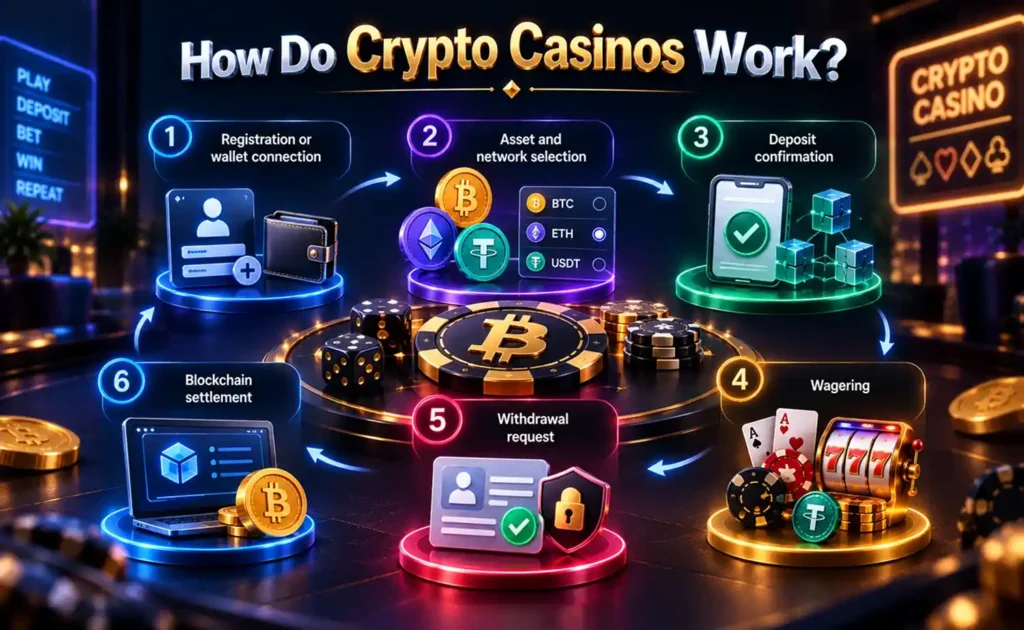
The deposit-to-payout cycle mirrors a fiat casino’s cashier flow, with two extra checkpoints: network selection and on-chain confirmation.
These terms get used interchangeably in marketing copy, but they describe different architectures. Knowing which one is actually being built changes the licence, the KYC flow, and the payment stack from day one.
| Model | Where value moves | Registration and KYC | Typical operator fit |
| Crypto casino | Off-chain balance, on-chain settlement | Standard KYC, adapted for crypto | Most new operators |
| Blockchain casino | On-chain, via smart contract | Often wallet-only at entry | Web3-native brands |
| Hybrid fiat and crypto | Both, on separate rails | Standard KYC across both | Operators migrating an existing fiat brand |
| Dice site | On-chain or provably fair off-chain | Frequently minimal | Niche crypto-native audiences |
The right model depends on the target market, the regulatory framework, and how much control the operator needs over funds and transactions.
Learning how to start a bitcoin casino, rather than bolting BTC onto a fiat cashier later, comes down to a few operator-side advantages:
The honest trade-off is a narrower mainstream audience. A crypto-first casino gives up some of the casual, card-paying players who still associate crypto with friction. Most operators solve this with a hybrid model rather than picking one audience exclusively.
Every launch decision below assumes a defined audience, so start there. Different players carry different qualifying questions:
Trying to serve all four from launch usually means building a platform for no one in particular. Picking one primary niche, and being specific about what the casino offers that established operators don’t, is what most crypto casino guides skip on the way to licensing.
Licensing isn’t just a compliance checkbox. It’s what payment service providers check before onboarding an operator, what game suppliers check before releasing their catalog, and what makes banking relationships possible at all. Not every jurisdiction that licenses gambling licenses crypto gambling in practice, either, so this research needs to happen before the platform and payment architecture are finalized, not after.
| Jurisdiction | Application fee | Annual fee | Approval time | Crypto stance | PSP and provider acceptance |
| Curaçao (CGA, under LOK) | Moderate | Moderate | Moderate | Generally crypto-permissive | Broad |
| Anjouan (OGRA) | Low | Low | Fast | Considered by crypto-focused operators | Moderate |
| Malta (MGA) | High | High | Long | Highly regulated; often restrictive for crypto-first models | Narrow for crypto-first brands |
| Isle of Man | High | High | Long | Permissive with conditions | Broad |
| Estonia (MTA) | Moderate | Moderate | Long | Often restrictive in practice | Narrow |
| Costa Rica | Low | Low | Fast | No formal gambling licence regime; needs specific legal assessment | Limited, informal |
Getting this table right before applying is the difference between launching on schedule and re-filing in a second jurisdiction six months in.
The cashier, not the game lobby, is where crypto-native software separates from a fiat platform with crypto bolted on. Evaluate any crypto casino software provider against:
A platform that treats crypto as an afterthought usually shows it first in the cashier: slow crediting, no network selection, bonus logic that ignores volatility.
| Route | Time to launch | Product control | Best fit |
| White label | Fastest | Limited | First launch, market testing |
| Turnkey | Moderate | Higher | Operators scaling past a first market |
| Custom build | Longest | Full | Established brands with specific crypto architecture needs |
Most first-time operators launch on white labels. Operators converting an existing fiat brand more often go turnkey. Custom builds stay the exception, reserved for teams whose architecture needs something a template genuinely can’t meet.
A 2026 launch coin set typically runs USDT, USDC, BTC, ETH, LTC, TRX, and SOL, mapped across networks including TRC20, ERC20, BEP20, Polygon, and Solana. The same coin often exists on more than one network, so the cashier needs to show the asset and network as two separate choices. Miss that, and players send funds to the wrong address.
Stablecoins carry most of the actual wagering volume on a well-run bitcoin casino or multi-coin platform, since they remove the volatility that would otherwise complicate bonus accounting mid-session. Operators still need to decide how deposits in other assets get converted, held, and settled.
Most licensed operators run custodial by default and treat non-custodial support as a secondary option.
A licence doesn’t guarantee a preferred crypto PSP will onboard the operator, so payment processing needs evaluating alongside licensing, not after it. Check any PSP against:
Treasury runs on a hot and cold wallet split: hot wallets hold enough liquidity to clear normal withdrawal volume, cold wallets hold the bulk of reserves offline. Stablecoin hedging on part of the treasury protects against a volatility swing turning a solvent operator insolvent overnight.
Keeping payment, wallet, and transaction data visible to the back office matters here. A casino management system is what most operators use to centralize that reporting rather than reconciling it manually.
A launch catalog typically mixes crash, dice, limbo, plinko, and mines, an aggregated slot portfolio, and live dealer content or sportsbook where the licence permits it. Sourcing that mix studio by studio is slower and more expensive than working through a casino game aggregator that already carries crypto-native titles alongside standard RNG content.
Provably fair titles let a player verify a round’s outcome against a published seed and nonce. It’s a trust mechanism, not a substitute for certification: a provably fair game still needs RNG testing from a body such as GLI-11, BMM Testlabs, or iTech Labs before a licence review will accept it. If the launch needs proprietary mechanics rather than an aggregated catalog alone, custom casino game development is the route for that.
A compliant crypto casino runs identity verification, wallet screening (the crypto-specific layer a fiat casino never needs), deposit thresholds, source-of-funds review on unusual transactions, suspicious activity escalation, deposit limits, self-exclusion tools, and Travel Rule readiness for cross-border transfers.
Anonymity-first positioning, once a genuine differentiator in this space, now fails licence review in most jurisdictions that take crypto gambling seriously. These controls need to connect to the player account layer rather than run as a separate system. A casino PAM is usually where registration status, limits, self-exclusion, and risk flags actually live.
Five channels realistically drive early volume: SEO and content targeting both operator- and player-side search intent, affiliate partnerships with crypto-gambling-focused publishers, Telegram and Discord communities where crypto-native players already gather, streamers covering crash and dice formats, and VIP or retention programs built around the same stablecoin balances used for regular play.
Paid search and mainstream social are largely closed to crypto gambling brands. Most major ad platforms restrict or ban gambling advertising and apply extra scrutiny to crypto terms specifically. A launch plan built around one channel is a launch plan built to stall once that channel closes.
There’s no single price for starting a crypto casino. Cost depends on platform model, jurisdiction, game portfolio, and compliance requirements more than on any one line item.
| Cost line | Lean launch | Mid-tier launch | Recurring or one-off | Main cost driver |
| Licence and company formation | Low | Moderate to high | One-off, plus annual renewal | Jurisdiction |
| Platform | Lower with white label | Higher with turnkey or custom | Recurring or project-based | Technology model |
| Game content | Aggregator-based | Broader direct portfolio | Recurring | Providers and commercial terms |
| PSP and compliance tooling | Low | Moderate to high | Recurring | Transaction volume |
| Marketing | Variable | Variable | Recurring | Target market and acquisition mix |
| Operating reserve | Moderate | High | Held, not spent | Withdrawal volume and volatility |
These are planning bands, not quoted prices. Actual costs move with jurisdiction, provider, and coin mix; request a build quote for numbers specific to a given launch plan.
The operating reserve is the line most breakdowns leave out or underweight. It’s working liquidity, not a launch expense, and it’s usually what decides whether a launch survives its first volatility spike.
Licence application, platform onboarding, and PSP integration can mostly run in parallel; content sourcing and QA follow once the platform is confirmed; soft launch comes last. The realistic range spans a few weeks at the fast end, for a white label build on a crypto-permissive licence, to several months for a custom build under a slower-moving regulator. The single most common cause of slippage is licence approval timing, not platform development.
Sequencing matters more than speed on any single item above. Getting the licence and platform decisions right early is what keeps the rest of this checklist straightforward instead of a scramble.
Work through this checklist with a team that’s taken crypto casinos from licence application to live traffic.
Sequencing decides whether a crypto casino launch goes smoothly or turns into a scramble. Confirm the licence and PSP compatibility before committing to a platform, and the coin, wallet, and compliance decisions that follow have room to be made properly instead of rushed. Skip that order, and even a well-funded build can stall on a mismatch a two-minute PSP check would have caught.
Getting that sequence right on your own is possible. Getting it right the first time, without re-filing paperwork in a second jurisdiction six months in, is easier with a team that has done it before. TIGCasino works with operators on licensing strategy, platform selection, and treasury setup before a single line of code gets written, so the build starts on solid ground instead of a guess.

Prish K

Request a Demo
Get a quick look at your potential earnings. Answer four simple questions and see your projected revenue for year one.
Keep in mind, this quick analysis is a preliminary guideline meant to kickstart your detailed market research. Best of luck!
Enter your email to receive your full cost breakdown, including projected net revenue, operating margin, and editable line items for your own planning.
Your inputs are used only to generate and deliver your report and are handled in line with TIGCasino's Privacy Policy.