Key Takeaways
Reviewed by TIGCasino Editors
Casino gamification gives players a reason to come back. Not a bonus. A reason.
Keeping a player is far cheaper than finding a new one. Most casinos also run the same games from the same studios now. For the majority of companies, what sets one brand apart from another is all the work an operator puts into the games from the very first login right up to the hundredth. This article looks at the main components, the psychology behind them, some program patterns that have proven themselves in practice, the genuine drawbacks, and also how to choose casino gamification software for your own platform.
Casino gamification is the use of game-style mechanics (levels, missions, points, badges, leaderboards) across an online casino. Separate spins and bets start adding up to visible progress. The games don’t change. Odds stay the same, and so does RTP. What changes is how a month of sessions feels to the player looking back on it.
Outside gambling, the textbook answer to what is gamification usually mentions fitness trackers or airline miles. Game design, borrowed for things that aren’t games. Ask what is gamification in iGaming, though, and the answer gets narrower. Here it’s a layer the operator runs across the entire lobby. A slot’s built-in bonus round belongs to the studio. It doesn’t count.
| Aspect | Standard Feature | Gamification Layer |
| Purpose | Gives access to games and payments | Gives players a reason to come back |
| Reward Trigger | A single action, such as a deposit | Progress across many actions |
| Player Role | Receives an offer | Works toward a goal |
| Retention Horizon | One session or one promotion | Weeks or months |
| Personalization | Mostly the same for everyone | Shaped by segment and behavior |
| Data Output | Deposits and bets | Progress, drop-off, and goal completion |
Picture a loop. A player does something. That earns points. The points nudge a progress bar along, and at some point the bar unlocks something new. A slightly harder goal shows up next, and round it goes again.
A tiny example makes it concrete. Ten spins on any slot earn 5 XP. At 50 XP, the player hits level 3. Level 3 opens a free-spin mission on a game added that week. Notice what never gets touched here. The game math. The player just gets a next session that carries on from the last one.
Where does online casino gamification live? Certain operators incorporate it directly into the platform, placing it next to the casino PAM, which stores the players’ accounts and wallets. In other cases, the feature is kept in a separate engagement layer. Typically, this type of layer sits within the CRM and is responsible for capturing real-time events on the platform and distributing the rewards.
See how player data, rewards, and campaigns connect in one back office.

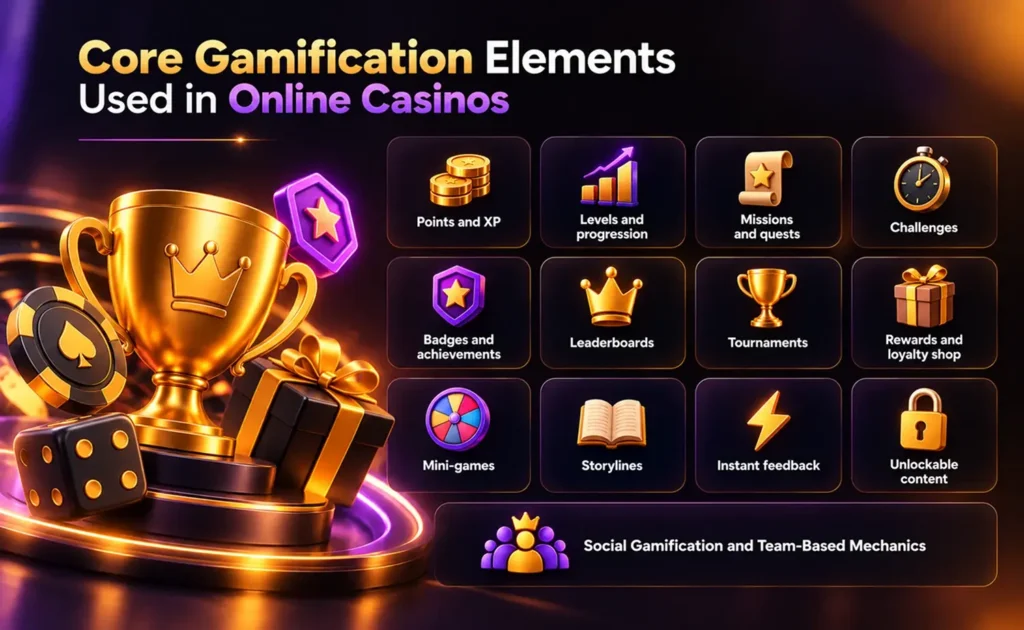
Most programs pull from the same box of gamification elements. Two casinos differ mainly in the mix. Sometimes the smartest choice is what got left out.
Most casino play happens alone. Social gamification changes that. Team tournaments split players into groups and score them together. A shared mission hands a whole community one target, and once it’s hit, everybody gets paid. Some casinos let players post achievements to a feed or a chat too. Why does this work? People like belonging to something. For an operator, that feeling costs very little next to a prize pool.
The psychology of gamification isn’t mysterious. It rests on a handful of effects behavioral researchers have poked at for decades.
Take unpredictable rewards. A random drop or a mystery box tends to hold attention far longer than a reward that turns up on a fixed schedule, because the player never quite knows when the next one is coming. Then there’s the goal-gradient effect. People speed up near a finish line, so a progress bar sitting at 90% quietly does a lot of work.
Leaderboards tap something else entirely. The urge to check where you stand. And unfinished tasks nag. A mission parked at four steps out of five has a way of pulling a player back in.
Every one of these can be pushed too far. A design that drives players past their own budget is a compliance problem, plain and simple. It’s a reputational one as well. Licensed operators should set limits on day one.
Search for gamification examples, and you’ll mostly find fitness apps. Language courses, too. Casinos lean on four patterns instead.
| Pattern | How It Works | KPI It Moves | Best For |
| Seasonal Mission Chain | A run of weekly missions under one theme, with a bigger reward at the end | 30-day retention | Regular mid-value players |
| Cross-Vertical XP Wallet | One XP balance earned in casino, live, and sportsbook | Cross-vertical migration | Single-product players |
| Tiered VIP Ladder | Visible levels with rising perks and personal hosts at the top | Lifetime value | High-value players |
| Prize-Wheel Reactivation | A free wheel spin sent to lapsed players after a set number of quiet days | Reactivation rate | Players at risk of churn |
Each pattern goes after one behavior. Seasonal chains keep regulars on a rhythm. An XP wallet gives a slots fan a reason to wander into the sportsbook. VIP ladders reward depth.
Prize wheels? Probably the cheapest excuse to log back in that exists.
None of these needs a big budget to trial. A first seasonal chain can run on points and badges alone for an entire season, with nothing of cash value changing hands until the numbers say it’s worth it. Cash prizes can come later, once completion rates prove the idea. Wheel prizes deserve one caution, though. They often carry wagering and bonus terms players can clearly decide whether a reactivated player sticks around or vanishes again.
Any look at the pros and cons of gamification should start with the upside. Here are the gamification advantages operators most often report:
Players return to finish something. No bonus required.
Daily missions and streaks drive logins forward.
If players stay longer and experiment with more products, they are typically worth more.
Completion and drop-off show what each segment cares about. That alone makes CRM choice a big deal, as this comparison of casino CRM providers shows.
Same games everywhere. The program around them is what sticks in a player’s memory.
Rewards earned over weeks are hard to farm. Sign-up offers aren’t.
Badges, levels and status cost little. Many carry no wagering at all.
Missions can point players at new games or another vertical.
Talk through platform options before committing a development budget.

The idea itself is rarely the problem. Most gamification disadvantages come from how a program gets built and then left alone. Here are the usual suspects, each with a fix.
| Pitfall | What Happens | Fix |
| Over-Complex Mechanics | Players cannot tell what to do next | One clear goal on screen at a time |
| One-Size-Fits-All Campaigns | The same mission bores some players and blocks others | Set difficulty by segment |
| Missing Feedback Moments | Progress happens, but nobody notices | Show every step the moment it counts |
| Misaligned Reward Value | Rewards feel cheap or cost too much | Price rewards against the effort asked |
| Reward-Economy Inflation | Points pile up and margins shrink | Cap issuance and review conversion monthly |
| Stale Content | The same missions run for months | Refresh themes on a set calendar |
| Build and Upkeep Cost | In-house builds run over budget | Start with a small scope or buy |
| Cross-Product Instability | Rewards arrive late or not at all | Test event delivery across every vertical |
Four steps. In this order. That’s how a rollout on an iGaming platform tends to go smoothly.
Pick one behavior before touching any mechanic. A common target is second deposit rate. Logins are accepted every week as well. And so does nudging players at slots to live casino. With one clear target comes the ability to be able to show, some months down the road, when someone in finance asks if the program is in the money, that you can show them a number. It also keeps the list of features from getting out of control for no reason.
New players need quick, easy wins. Regulars warm to streaks and seasonal chains. High-value players? Status and access, mostly. Map each segment to two or three mechanics at most. Use the segments already living in your casino CRM software. Giving everyone everything rarely works.
At-risk and self-excluded players are not allowed to play in any campaign. Automatically. Fast. Rewards terms should be visible and apparent to anyone who is interested in opting in. Any mechanic who’ll pay more for longer time or bigger wagers requires a second glance in regulated markets. Rewards of high value should come after an affordability assessment. If it gets right at launch it’s just a little bit more expensive than the regulator asking and you getting it right after.
Use one segment and one mechanic. Wait a couple of weeks. Only then scale. Most of what’s worth watching is covered by five KPIs:
Reward cost climbing faster than retention? Tune the economy first. More features can wait.
Get a scoped plan for platform, CRM, and game content in one quote.
Casino gamification software tends to eat the biggest slice of the budget. So the first question is blunt. Should you build anything at all?
| Factor | Build In-House | Buy a Gamification Platform |
| Time to Market | Months, often longer | Weeks once integrated |
| Upfront Cost | High development spend | License or revenue-share fee |
| Control | Full control of every mechanic | Limited to what the vendor supports |
| Maintenance | Your team, indefinitely | Mostly the vendor |
Building fits operators who already have a strong product team, a long runway and mechanics in mind that no vendor on the market currently sells. That route often runs through bespoke casino software. Everyone else usually buys. It’s faster, especially on a turnkey casino solution that already handles player accounts and wallets.
Any gamification software on the shortlist should get through these ten checks before a contract gets signed:
These tests are needed to be passed by any software that is in the shortlist before a contract is finalized:
For a licensed operator, number ten matters most. A tool that nails the other nine and fumbles compliance turns expensive later. Manual workarounds pile up. Regulators notice.
AI in gamification mostly does what a sharp CRM team already does. Just for every player at once.
Three uses are live right now. Churn models spot players drifting away and send a mission before they disappear. Mission difficulty adjusts by segment on its own, staying tough enough to feel earned without turning into a wall. Reward timing follows each player’s usual login hours.
The same models can watch for risk as well. Deposits suddenly larger than normal. Sessions at 3 a.m. Signs of chasing losses. Any of these can trigger a responsible gambling check and pause a player’s campaigns. Few vendors offer that yet.
Some of this is already here. Real-time reward engines, social features and AI-tuned missions run at plenty of casinos today. Mobile mini-games keep spreading. So do tournaments that pull titles from a big catalog through a casino game aggregator.
Metaverse casinos sit further out. 3D social floors, VR and AR tables, blockchain-verified achievements and tradeable rewards have all grabbed headlines. Audiences have stayed small. Most regulated markets also lack any clear licensing route for them, which leaves a licensed operator with very little to build on even if the audience did show up. Worth watching? Yes. Worth building for? Only if a brand’s players already hang out there.
At TIGCasino, the parts of gamification depend on what’s already shipped with the platform. The casino management system and PAM hold player accounts, wallets, and the events every mission reads. The casino CRM software holds segments and campaign triggers. The game aggregator supplies titles for missions and tournaments to point at. Operators can launch on a turnkey build or a white-label casino solution with all of that in place. The mechanics come after, chosen for their own players.

Prish K


Request a Demo
Solicitar una Demostración
Get a quick look at your potential earnings. Answer four simple questions and see your projected revenue for year one.
Keep in mind, this quick analysis is a preliminary guideline meant to kickstart your detailed market research. Best of luck!
Enter your email to receive your full cost breakdown, including projected net revenue, operating margin, and editable line items for your own planning.
Your inputs are used only to generate and deliver your report and are handled in line with TIGCasino's Privacy Policy.